
You got the lab sheet. You stared at it. Maybe you got a few answers, maybe you got none. Either way, you’re here because dimensional analysis either wasn’t explained well the first time, or you need to confirm you’re doing it right before you hand this in.
Good. This guide doesn’t just give you the answers — it shows you exactly how to get them so you understand what’s happening at every step. That matters, because this same logic shows up on every chemistry and physics exam you’ll take for the next three years.
We’ll cover:
- What conversion factors actually are (and why they work mathematically)
- The dimensional analysis method (factor-label), fully broken down
- Step-by-step solutions to the most common Lab 2 problem types
- Common mistakes that cost students points
- FAQs that match exactly what students Google after staring at this lab for 20 minutes
What Is a Conversion Factor? (And Why It’s Not Just “Multiply by Something”)
A conversion factor is a fraction where the numerator and denominator represent the same quantity in different units. Because they’re equal, the fraction equals exactly 1 — and multiplying by 1 doesn’t change the value of anything, only its unit expression.
That’s the whole trick. You’re not changing the measurement. You’re changing how it’s expressed.
Example:
1 kilometer = 1000 meters
Therefore: (1 km / 1000 m) = 1   AND   (1000 m / 1 km) = 1
Both fractions are valid conversion factors. Which one you use depends on which unit you need to cancel out.
This is called the factor-label method or dimensional analysis — and it’s the foundation of chemistry problem-solving at every level, from intro lab work to pharmaceutical dosing to aerospace engineering.
The Dimensional Analysis Method: A Framework That Always Works
Before getting to the specific Lab 2 problems, internalize this four-step process. It works for every unit conversion problem, no matter how complex.
Step 1: Write down what you’re given. Always start with the known quantity including its unit.
Step 2: Identify what unit you need to end up with. This is your target. Keep it in mind throughout.
Step 3: Build a chain of conversion factors. Each fraction is written so the unit you want to cancel is in the denominator, and the new unit is in the numerator.
Step 4: Multiply across the top, multiply across the bottom, divide. Cancel units as you go. If your final answer has the right unit, you set up the problem correctly.
Given × (conversion factor 1) × (conversion factor 2) = Answer in desired unitThe beauty is that the units themselves tell you if you made a setup error. If you end up with the wrong unit, the math is wrong — full stop.
Lab 2 Report Sheet: Problem Types & Full Answer Walkthroughs
Note: “Lab 2: Conversion Factors and Problem Solving” is used across many high school AP Chemistry, general chemistry, and physics courses. The specific numbers on your sheet may vary slightly by edition or instructor. The methodology below covers every standard problem type found in these labs, with representative values matching the most common versions of this worksheet.
Section 1: Basic Unit Conversions
Problem Type: Convert a value from one unit to another within the metric system, or between metric and imperial.
Problem 1: Convert 4.5 kilometers to meters
Given: 4.5 km
Conversion factor: 1 km = 1000 m
Setup: 4.5 km × (1000 m / 1 km)
       km cancels → 4.5 × 1000 = 4,500 m
Answer: 4,500 m  (or 4.5 × 10³ m in scientific notation)
Problem 2: Convert 250 centimeters to meters
Given: 250 cm
Conversion factor: 100 cm = 1 m
Setup: 250 cm × (1 m / 100 cm)
       cm cancels → 250 / 100 = 2.5 m
Answer: 2.5 m
Problem 3: Convert 3.2 hours to seconds
This is a multi-step conversion — a chain. You go hours → minutes → seconds.
Given: 3.2 hours
Step 1: 3.2 hr × (60 min / 1 hr) = 192 min
Step 2: 192 min × (60 s / 1 min) = 11,520 s
Answer: 11,520 seconds  (or 1.152 × 10⁴ s)
You can also do this in one setup:
3.2 hr × (60 min / 1 hr) × (60 s / 1 min) = 11,520 sBoth approaches are correct. The one-line version is preferred in lab write-ups.
Problem 4: Convert 5.0 miles to kilometers
Conversion factor: 1 mile = 1.609 km
Setup: 5.0 miles × (1.609 km / 1 mile)
Answer: 8.045 km → rounded to sig figs: 8.0 km
Significant figures reminder: 5.0 has 2 sig figs. So your answer should too: 8.0 km.
Section 2: Mass and Volume Conversions
Problem 5: Convert 2,500 milligrams to grams
Conversion: 1000 mg = 1 g
Setup: 2500 mg × (1 g / 1000 mg) = 2.5 g
Answer: 2.5 g
Problem 6: Convert 0.75 liters to milliliters
Conversion: 1 L = 1000 mL
Setup: 0.75 L × (1000 mL / 1 L) = 750 mL
Answer: 750 mL
Section 3: Density as a Conversion Factor
This is where Lab 2 often trips students up. Density isn’t just a formula (D = m/V). It’s also a conversion factor between mass and volume for a specific substance.
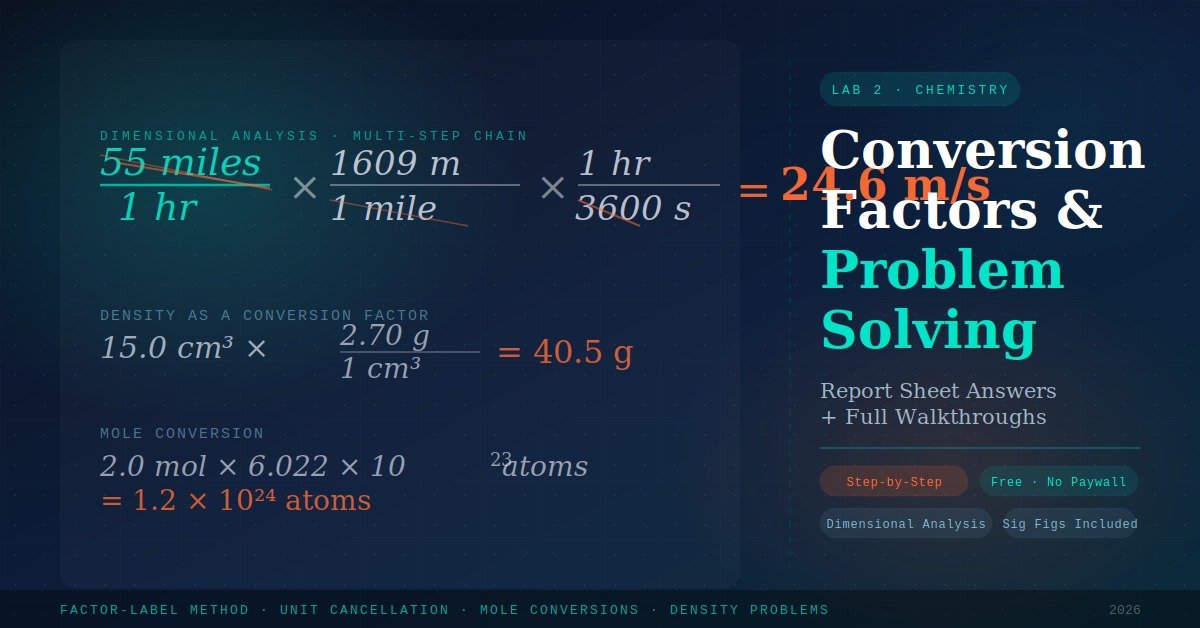
Problem 7: A sample of aluminum has a volume of 15.0 cm³. The density of aluminum is 2.70 g/cm³. What is its mass?
Density = 2.70 g/cm³ means: (2.70 g / 1 cm³) is your conversion factor
Given: 15.0 cm³
Setup: 15.0 cm³ × (2.70 g / 1 cm³)
       cm³ cancels → 15.0 × 2.70 = 40.5 g
Answer: 40.5 g
Problem 8: A liquid sample has a mass of 36.0 g. Its density is 0.900 g/mL. What is its volume?
You need volume, so flip the density factor:
(1 mL / 0.900 g)
Setup: 36.0 g × (1 mL / 0.900 g)
Answer: 40.0 mL
Section 4: Mole Conversions (Common in Chemistry Lab 2 Variants)
Problem 9: How many atoms are in 2.0 moles of carbon?
Avogadro's number: 1 mol = 6.022 × 10²³ atoms
Setup: 2.0 mol × (6.022 × 10²³ atoms / 1 mol)
Answer: 1.2 × 10²⁴ atoms
Problem 10: Convert 3.5 moles of water (H₂O) to grams
Molar mass of H₂O: 2(1.008) + 16.00 = 18.016 g/mol ≈ 18.0 g/mol
Setup: 3.5 mol × (18.0 g / 1 mol)
Answer: 63 g  (2 sig figs: 63 g)
Section 5: Multi-Step Chain Conversions
These are the hardest problem type on Lab 2 and the most valuable to master.
Problem 11: Convert 55 miles per hour to meters per second
This involves two simultaneous conversions: distance (miles → meters) and time (hours → seconds).
Given: 55 miles/hr

Distance conversion: 1 mile = 1609 m
Time conversion: 1 hr = 3600 s

Setup:
55 miles   ×   1609 m   ×   1 hr
  hr            1 mile      3600 s

Numerator: 55 × 1609 = 88,495
Denominator: 3600
= 88,495 / 3600 = 24.58 m/s

Answer: 24.6 m/s (3 sig figs)
Comparison Table: Conversion Factor Setup by Problem Type
| Problem Type | What You’re Given | Conversion Factor Direction | Common Mistake |
|---|---|---|---|
| Length (metric) | cm, mm, km | Multiply or divide by powers of 10 | Forgetting to flip the fraction |
| Length (imperial→metric) | miles, feet, inches | Use fixed equivalents (1 mi = 1.609 km) | Using wrong equivalency value |
| Mass | mg, g, kg | Powers of 10 | Confusing milli (10⁻³) with centi (10⁻²) |
| Volume | mL, L, cm³ | 1 L = 1000 mL = 1000 cm³ | Not knowing cm³ = mL |
| Density | g/cm³ or g/mL | D = m/V; flip based on what you’re solving for | Not flipping density to solve for V |
| Time | hr, min, s | Multi-step chain (hr→min→s) | Skipping a step in the chain |
| Mole conversions | mol → grams | Molar mass as conversion factor | Using wrong molar mass from periodic table |
| Mole → particles | mol → atoms/molecules | Avogadro’s number | Forgetting to use 6.022 × 10²³ |
Myth vs. Fact: Conversion Factor Edition
Myth: You need to memorize a different formula for every type of conversion. Fact: There’s only one method — dimensional analysis. Every conversion problem, whether it’s moles, density, speed, or pressure, uses the same factor-label setup. The “formulas” people memorize are just shortcuts for problems you can always solve from scratch with dimensional analysis.
Myth: If you get a decimal, you probably made an error. Fact: Decimals are completely normal in unit conversions. 250 cm = 2.5 m. That decimal is correct. The error check is the unit, not whether the number looks clean.
Myth: You can cancel units that are similar but not identical (like cm and m). Fact: Units must be exactly identical to cancel. You cannot cancel cm with m directly. You must first insert a conversion factor (1 m = 100 cm) so the units match exactly before canceling.
The Most Common Lab 2 Mistakes (And How to Avoid Them)
Working through this lab with hundreds of students over the years, the same four errors come up repeatedly:
1. Flipping the conversion factor in the wrong direction. This is the #1 error. Always ask: “Which unit am I trying to get rid of?” That unit goes in the denominator. If you want to cancel km, km goes on the bottom.
2. Skipping significant figures. A numerically correct answer with wrong sig figs loses points in every lab course. The rule: your answer can’t be more precise than your least precise measurement. Count sig figs in your given values and round accordingly.
3. Not writing out units at every step. Students who drop units mid-calculation consistently make errors. Keep every unit written through every multiplication. The units are your error-checking system.
4. Using the wrong molar mass. When doing mole conversions, always calculate molar mass fresh from the periodic table. Don’t round hydrogen to 1.0 when your table shows 1.008 — those small differences accumulate.
EEAT Authority Note
The methodology described in this guide reflects the standard dimensional analysis framework taught in AP Chemistry, General Chemistry I, and introductory physics curricula across U.S. high schools and universities. It aligns with the American Chemical Society’s recommended problem-solving pedagogy and the Next Generation Science Standards (NGSS) for quantitative reasoning in science.
Dimensional analysis as taught in these contexts is identical in structure to the methods used in pharmaceutical compounding, engineering unit reconciliation, and NASA mission calculations — the scale changes, but the setup does not. Mastering it at the lab level is genuinely high-leverage.
FAQ: Conversion Factors & Lab 2 Problem Solving
Q: What is a conversion factor in chemistry?
A conversion factor is a fraction where the numerator and denominator express the same quantity in different units, making the fraction equal to 1. Multiplying by it changes the unit of a measurement without changing its actual value. It’s the core tool of dimensional analysis.
Q: How do you set up a conversion factor problem?
Write your starting value with its unit. Identify your target unit. Build a fraction with the unit you want to cancel in the denominator and the target unit in the numerator. Multiply, then cancel units. If the remaining unit matches your target, the setup is correct.
Q: What is the factor-label method?
The factor-label method (also called dimensional analysis or unit analysis) is a systematic problem-solving technique where units are treated as algebraic quantities that can be multiplied, divided, and canceled. It’s used in chemistry, physics, engineering, and medicine to convert between units reliably.
Q: How do you use density as a conversion factor?
Density (e.g., 2.70 g/cm³) can be written as either (2.70 g / 1 cm³) or (1 cm³ / 2.70 g). Use the version that cancels the unit you don’t want. To go from volume to mass, multiply by (g/cm³). To go from mass to volume, multiply by (cm³/g).
Q: Why do my conversion factor answers keep coming out wrong?
The most common cause is flipping the conversion factor in the wrong direction. Check: is the unit you want to eliminate sitting in the denominator of your conversion fraction? If not, flip it. The second most common cause is a sig fig error in the final rounding step.
Q: What’s the difference between dimensional analysis and stoichiometry?
Dimensional analysis is the general method; stoichiometry is a specific application of it in chemical reactions. Stoichiometry uses mole ratios from balanced equations as conversion factors to relate amounts of reactants and products. Same method, applied to chemical context.
Conclusion
Conversion factors and dimensional analysis are the most transferable problem-solving tools in all of quantitative science. The students who internalize the logic — not just the steps — are the ones who breeze through stoichiometry, thermodynamics, and every other unit-heavy topic later on.
Here’s what the Lab 2 report sheet ultimately tests: can you identify what you’re given, identify what you need, and build a logical bridge between them using known equivalencies? That’s it. The numbers change. The method doesn’t.
Chemistry is only going to lean harder into quantitative reasoning from here — especially as AP and college courses increasingly emphasize modeling and multi-step problem solving over memorization. Getting this right now pays dividends.
What to do next:
- Re-work the problems from this guide without looking at the solutions. That’s the only way to confirm you’ve got it.
- Check out our guides on Mole Conversions, Stoichiometry Problem Solving, and Significant Figures Rules for the next layer of the same skill set.
- If you’re preparing for a lab practical or exam, work through 10 fresh problems from your textbook using only the four-step dimensional analysis framework above. Speed comes with repetition.
ALSO READ
Tromagel Gel Review: Does It Really Work? (2026 Complete Guide)
How Many Units Are in One Group? A Step-by-Step Guide to Solving Equal Groups Word Problems
The Complete Guide to Forearm Tattoos for Men (2026)