Why Decaf Coffee Still Contains Caffeine
Here’s the short version: no decaffeination method on earth removes 100% of caffeine from a coffee bean.
Coffee beans contain roughly 1,000 naturally occurring chemical compounds, and caffeine is tightly bound to many of them. Every commercial decaffeination process — whether it uses water, solvents, or pressurized gas — targets caffeine molecules specifically, but some always remain embedded in the bean’s cellular structure.
The industry benchmark, enforced by the USDA, requires that decaf coffee have at least 97% of its caffeine removed before it can be labeled “decaffeinated.” The European Union sets an even stricter standard: no more than 0.1% caffeine by dry weight for roasted beans, which works out to roughly 99.9% removal.
So when you see “decaf” on a bag, it means most of the caffeine is gone. Not all of it. The leftover amount is tiny — but it’s not zero.
The Actual Numbers: Caffeine Content by Cup Size
Here’s what the research shows for brewed decaf coffee (drip method):
| Cup Size | Caffeine Range | Average |
|---|---|---|
| 8 oz (standard cup) | 2–7 mg | ~5 mg |
| 12 oz (tall / small) | 5–14 mg | ~10 mg |
| 16 oz (grande / medium) | 8.6–13.9 mg | ~9.4 mg |
These ranges come from peer-reviewed research, including a widely cited study published in the Journal of Analytical Toxicology that tested decaf samples from nine U.S. coffee chains and local shops. The takeaway: even within the same cup size, caffeine varies significantly depending on the beans, the roast, and the brewing process.
For context, a single can of Coca-Cola contains about 34 mg of caffeine. An ounce of dark chocolate has around 12 mg. A typical cup of decaf lands somewhere below both of those.
Caffeine in Decaf Coffee by Brand
Not all decaf is created equal. Coffee chains tend to run higher than what you’d brew at home because they use more grounds per serving and stronger extraction methods.
| Brand / Source | Serving Size | Caffeine (mg) |
|---|---|---|
| Home-brewed decaf (generic) | 8 oz | 2–7 |
| Folgers Instant Decaf | 8 oz | ~0–2 |
| Starbucks Decaf Pike Place | 8 oz (short) | ~15 |
| Starbucks Decaf Pike Place | 12 oz (tall) | ~20 |
| Starbucks Decaf Pike Place | 16 oz (grande) | 12–25 |
| Dunkin’ Decaf | 16 oz | ~7 |
| Starbucks Decaf Espresso | 1 oz (single shot) | 3–15.8 |
| Starbucks Decaf Latte (tall) | 12 oz | ~15 |
| Dunkin’ Decaf Latte | 16 oz | ~7 |
A few things stand out from this data. Starbucks decaf consistently runs higher than most grocery-store decaf brands. This makes sense: Starbucks uses a higher coffee-to-water ratio and longer extraction in its drip brewing, both of which pull more of everything — including residual caffeine — out of the grounds.
If you’re someone who’s extremely sensitive to caffeine, Folgers instant decaf or a Swiss Water Process whole-bean coffee brewed at a standard ratio will keep you at the lowest possible levels.
How Decaf Coffee Is Made: The Four Main Methods
All decaffeination happens before roasting, while the beans are still green. The process always starts the same way — the beans are soaked or steamed to make caffeine molecules accessible — but the method of extracting that caffeine differs significantly.
Swiss Water Process
This is the only commercially available method that uses no chemical solvents at all. Green beans are soaked in a solution called Green Coffee Extract (GCE), which is essentially water pre-loaded with all of coffee’s soluble flavor compounds except caffeine. Because the GCE is already saturated with flavor molecules, only caffeine migrates out of the beans via osmosis. The caffeine-laden water then passes through activated charcoal filters that trap caffeine molecules. The cycle repeats until the beans reach 99.9% caffeine-free status.
The Swiss Water Process facility operates in Vancouver, BC, using glacially sourced water. It’s the method most often associated with organic and specialty-grade decaf.
CO₂ (Carbon Dioxide) Process
Green beans are placed in a sealed chamber and exposed to supercritical CO₂ — carbon dioxide pressurized until it behaves like both a liquid and a gas simultaneously. In this state, CO₂ selectively binds to caffeine molecules while leaving most other flavor compounds alone. When the pressure drops, the CO₂ evaporates and the caffeine is left behind.
This method is chemical-free and preserves flavor well, but the equipment is expensive, which makes it more common in large-scale commercial operations (brands like Illy use it as their primary decaf method).
Solvent-Based Process (Methylene Chloride or Ethyl Acetate)
The most common and cheapest method. Green beans are either directly soaked in a chemical solvent or indirectly treated via a water intermediary. Methylene chloride and ethyl acetate both bind to caffeine molecules and strip them from the beans.
The solvents evaporate during roasting, and the FDA considers the trace amounts remaining (parts per million) to be safe. That said, many specialty roasters avoid this method because the solvents can strip aromatic compounds along with caffeine, resulting in a flatter-tasting cup.
Ethyl acetate is sometimes marketed as “natural” because it’s found in fruit, but the compound used commercially is almost always synthesized. It’s a bit of a marketing gray area.
Mountain Water Process
Similar to Swiss Water but operated by Descamex in Mexico using glacier water from Pico de Orizaba. The chemistry is the same — osmosis-driven caffeine extraction via a flavor-saturated water solution followed by carbon filtration. It’s chemical-free and produces results comparable to Swiss Water, though with slightly different flavor characteristics depending on the source water.
What Affects Caffeine Levels in Your Decaf Cup
Even after decaffeination, several variables determine how much caffeine ends up in your mug:
Bean variety matters. Robusta beans naturally contain nearly twice the caffeine of Arabica beans. If your decaf starts with Robusta (less common but not unheard of), the residual caffeine will be higher even after 97% removal.
Roast level plays a smaller role than you’d think. Light and dark roasts contain roughly the same amount of caffeine per bean. However, dark roasts lose more mass during roasting, so if you’re measuring by weight (scoops), you’ll use more dark-roast beans per cup — potentially extracting slightly more caffeine.
Brewing method is the biggest variable. Longer contact time between water and grounds extracts more caffeine. Cold brew steeps for 12–24 hours; espresso pushes water through grounds in 25 seconds. French press sits somewhere in between. More grounds, finer grind, and longer brew time all push caffeine numbers upward.
Serving size is the silent multiplier. A “cup” at home is 8 ounces. A “grande” at Starbucks is 16 ounces. You’re drinking twice the volume and extracting caffeine from twice the grounds.
Decaf Coffee Myths vs. Facts
Myth: Decaf coffee is 100% caffeine-free. Fact: Every cup of decaf contains trace caffeine — typically 2 to 15 mg. The USDA standard requires 97% removal, not complete elimination.
Myth: Drinking decaf is the same as drinking water, caffeine-wise. Fact: Research suggests that consuming 5 to 10 cups of decaf could deliver caffeine equivalent to 1–2 cups of regular coffee. For most people that’s fine, but it adds up for those on strict caffeine restrictions.
Myth: The chemicals used in decaffeination are dangerous. Fact: The FDA has reviewed all major decaffeination methods and found no safety concerns. Solvent residues in finished coffee are measured in parts per million — far below any threshold for biological effect. If you’re still uncomfortable, Swiss Water and CO₂ methods use no chemical solvents at all.
Myth: Decaf tastes bad because it’s lower quality coffee. Fact: Decaf historically did use lower-grade beans, but that’s changed dramatically in the specialty coffee world. Swiss Water Process decaf, in particular, can be remarkably flavorful because caffeine itself contributes bitterness — removing it sometimes lets more nuanced origin flavors emerge.
Myth: Dark roast has less caffeine than light roast. Fact: Bean for bean, caffeine content is nearly identical across roast levels. The perception that dark roast is “stronger” comes from its bolder flavor, not its caffeine concentration.
Who Needs to Pay Attention to Caffeine in Decaf
For the average healthy adult, 5–15 mg of caffeine in a cup of decaf is physiologically insignificant. The FDA’s recommended daily limit is 400 mg — you’d need to drink roughly 40–50 cups of decaf to approach that.
But certain groups should be more careful:
Pregnant individuals. Most medical guidelines recommend keeping caffeine under 200 mg per day during pregnancy. A cup or two of decaf fits comfortably within that, but it’s worth factoring in if you’re also consuming chocolate, tea, or soda.
People with caffeine sensitivity. Research from Johns Hopkins has shown that some individuals can detect the subjective effects of caffeine at doses as low as 10 mg. If you’re in that group, multiple cups of decaf — especially from a chain like Starbucks — could cross your threshold.
Those on certain medications. Some drugs interact with caffeine or are affected by even small amounts. If your doctor has told you to avoid caffeine entirely, discuss whether decaf is acceptable or if you need a truly caffeine-free alternative like herbal tea or rooibos.
People with certain heart conditions or anxiety disorders. Even small amounts of caffeine can increase heart rate, blood pressure, or feelings of agitation in susceptible individuals.
An Industry Perspective on Decaf Quality
Having tracked the decaf market closely over the past several years, one of the biggest shifts has been the entry of specialty roasters into the decaf space. A decade ago, “good decaf” was an oxymoron in most coffee circles. Roasters treated it as an afterthought — low-grade beans, solvent-processed, stale by the time it hit the shelf.
That’s no longer the case. The Swiss Water facility in Vancouver has partnered with some of the top specialty importers in North America, and the CO₂ process has become sophisticated enough to preserve single-origin characteristics that would have been stripped out by older methods.
The common mistake we still see: people buying decaf ground coffee in bulk from grocery stores and wondering why it tastes flat. Decaf is more perishable than regular coffee because the decaffeination process makes beans more porous and susceptible to oxidation. Buying whole bean, storing properly, and grinding fresh makes a bigger difference for decaf than it does for regular coffee.
If you’re serious about minimizing caffeine and maximizing flavor, look for bags that specify Swiss Water Process or CO₂ method on the label. These aren’t just marketing claims — they indicate a meaningfully different process that produces a better cup with lower residual caffeine.
Frequently Asked Questions
Does decaf coffee have caffeine?
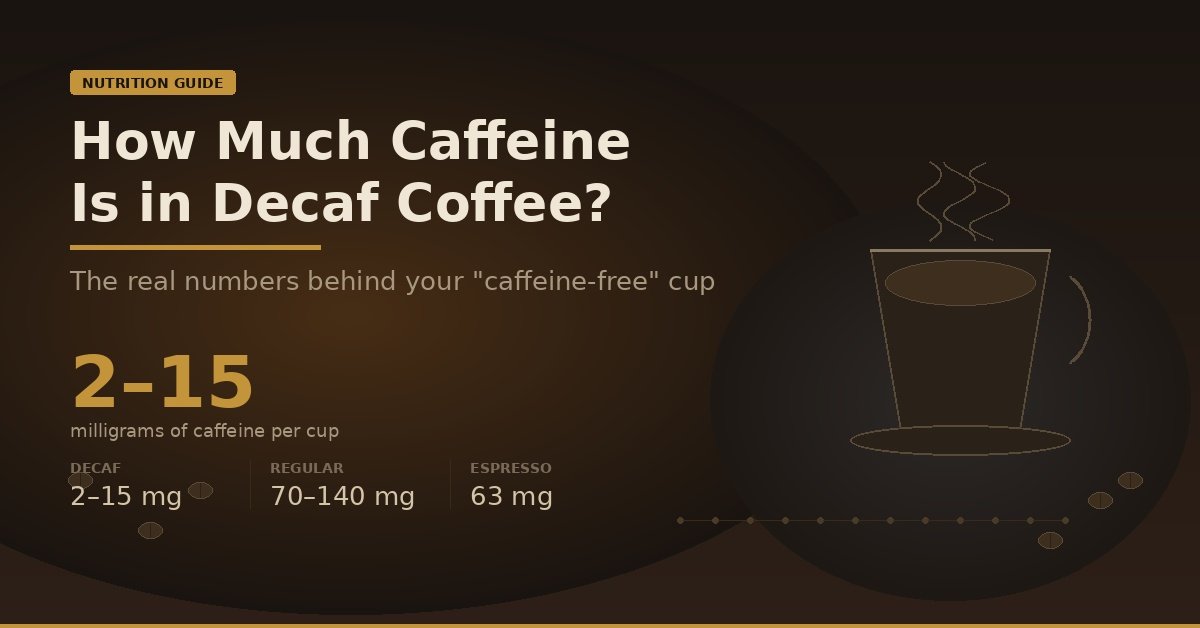
Yes. Decaf coffee contains a small amount of caffeine — typically between 2 and 15 mg per 8-ounce cup. Decaffeination removes 97% to 99.9% of caffeine depending on the method used, but it’s chemically impossible to eliminate every molecule. For most people, the residual amount has no noticeable effect.
How much caffeine is in Starbucks decaf coffee?
A tall (12 oz) Starbucks Decaf Pike Place Roast contains approximately 20 mg of caffeine. A grande (16 oz) contains roughly 12–25 mg. Starbucks decaf espresso shots range from 3 to 15.8 mg each. These numbers are higher than typical home-brewed decaf because Starbucks uses a higher grounds-to-water ratio.
Is decaf coffee safe during pregnancy?
Most medical organizations consider moderate decaf consumption safe during pregnancy. With 2–15 mg of caffeine per cup, decaf falls well under the commonly recommended 200 mg daily limit. However, consult your healthcare provider if you have specific concerns about caffeine interactions.
How is decaf coffee made?
Decaffeination happens before roasting, using one of four main methods: the Swiss Water Process (water and carbon filtration), the CO₂ process (pressurized carbon dioxide), or solvent-based methods using methylene chloride or ethyl acetate. All methods soak or steam green beans to make caffeine accessible, then extract it through different mechanisms.
What decaf coffee has the least caffeine?
Decaf coffees processed with the Swiss Water method tend to have the lowest residual caffeine because the process achieves 99.9% removal. Among commercial brands, Folgers instant decaf has been measured at near-zero caffeine levels. For brewed decaf, using fewer grounds and a shorter brew time will minimize caffeine further.
Can decaf coffee keep you awake?
For most people, no. The caffeine in a single cup of decaf (2–15 mg) is well below the threshold needed to affect sleep in the average adult. However, individuals with extreme caffeine sensitivity may notice mild effects, particularly if they drink several cups in the evening. If you’re unsure, try switching to herbal tea after dinner.
The Bottom Line
Decaf coffee isn’t caffeine-free, but it’s close. A typical cup contains 2–15 mg of caffeine — roughly 97% less than regular coffee and less than what you’d find in a bar of dark chocolate. The exact amount depends on the bean, the decaffeination method, the roast, the brew method, and how much coffee you’re using per cup.
For the vast majority of people, decaf is an entirely practical way to enjoy coffee without meaningful caffeine intake. If you’re managing a medical condition or extreme sensitivity, the numbers above give you what you need to make informed choices — and opting for Swiss Water Process or CO₂ decaf will keep you at the lowest possible levels.
The decaf category continues to improve rapidly. Better beans, better processing, and more transparency from roasters mean that choosing decaf no longer requires sacrificing flavor. The stigma is fading, and the coffee is getting genuinely good.
Next steps: If you’re comparing specific brands, use the table above to check your favorites. If you’re exploring decaf for the first time, start with a whole-bean Swiss Water Process coffee from a specialty roaster — you might be surprised at how much it tastes like the real thing. Because, chemically speaking, it mostly is.