
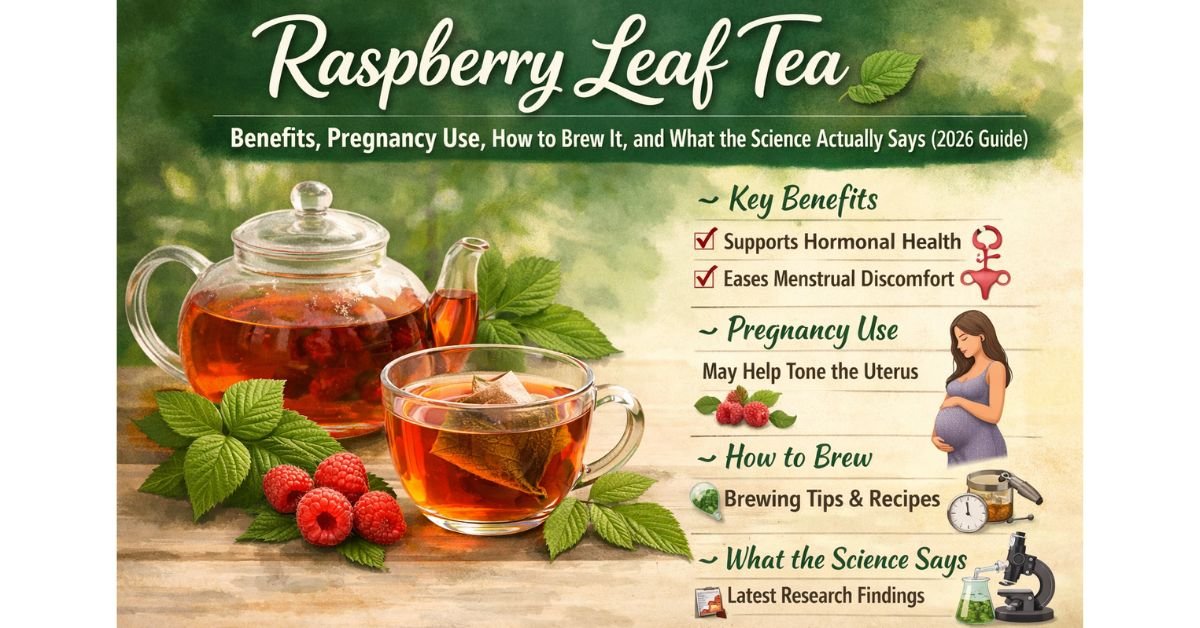
What Is Raspberry Leaf Tea, and Why Does Everyone Keep Talking About It?
Raspberry leaf tea is having a moment — and honestly, it’s overdue.
This caffeine-free herbal tea is made from the dried leaves of the red raspberry plant (Rubus idaeus), and it has been used in traditional medicine across European, Native American, and Asian cultures for centuries. Women have been drinking it to support reproductive health since long before anyone knew what a polyphenol was.
But here’s what catches most people off guard: it doesn’t taste like raspberries. Not even close. The flavor is closer to a mild black tea — earthy, slightly grassy, with a clean finish. You’re steeping the leaves, not the berries, and that distinction matters for both taste and nutrition.
What’s driving renewed interest is a combination of things. A 2025 clinical trial published in Nutrients found that raspberry leaf tea can reduce blood sugar spikes after eating sugar by up to 43.6%. Meanwhile, the conversation around natural labour preparation continues to grow among midwives and expectant mothers. And for people who simply want a nutrient-dense, caffeine-free drink that isn’t another cup of chamomile, raspberry leaf tea fits the bill.
This guide covers what the research actually supports, where the evidence is still thin, how to brew it properly, who should be cautious, and how to make it part of your daily routine — whether or not you’re pregnant.
What’s Inside the Leaves: Nutritional Profile and Key Compounds
The leaves of Rubus idaeus carry a surprisingly dense nutritional payload for something you’re steeping in hot water. The key nutrients and bioactive compounds include:
Vitamins and minerals: Raspberry leaves contain vitamin C, vitamin E, several B vitamins, iron, calcium, magnesium, potassium, and manganese. In fact, raspberry leaf ranks among the highest known plant sources of manganese, containing roughly 14.6 mg per 100g of dried leaf.
Polyphenols: This is where the real pharmacological interest lies. A 2025 LC-MS analysis identified 37 distinct polyphenolic compounds in a standard raspberry leaf tea infusion. The dominant compounds include ellagitannins, ellagic acid, quercetin-3-O-glucuronide, and various flavonoids. A five-minute steep of 10g of dried leaf yields approximately 50 mg of total polyphenols, with ellagitannins making up roughly 38 mg of that total.
Fragarine: An alkaloid found specifically in raspberry leaves. This compound is believed to help tone smooth muscle tissue, including the uterus, though the mechanism is not fully understood.
Tannins: Responsible for the tea’s mild astringent quality, tannins also contribute antioxidant activity and may support digestive comfort.
| Compound Category | Key Examples | Primary Activity |
|---|---|---|
| Ellagitannins | Ellagic acid, sanguiin H-6 | Antioxidant, enzyme inhibition, blood sugar modulation |
| Flavonoids | Quercetin-3-O-glucuronide, kaempferol derivatives | Anti-inflammatory, antioxidant |
| Phenolic acids | Gallic acid, caffeic acid | Free radical scavenging, potential anti-cancer activity |
| Minerals | Iron, calcium, potassium, manganese | Bone health, blood health, electrolyte balance |
| Alkaloids | Fragarine | Smooth muscle toning |
One important note: tea bags deliver fewer of these compounds than loose-leaf preparations. The processing involved in creating tea bags removes or degrades some of the beneficial compounds. If you’re drinking raspberry leaf tea specifically for health benefits, loose-leaf is the better choice.
Raspberry Leaf Tea Benefits: What the Evidence Supports
1. Blood Sugar Regulation (Strongest Recent Evidence)
The most exciting research on raspberry leaf tea in recent years has nothing to do with pregnancy. A September 2025 randomised crossover study published in Nutrients (Alkhudaydi & Spencer, University of Reading) tested raspberry leaf tea alongside sugar loads in 22 healthy adults. The findings were significant.
When participants drank raspberry leaf tea with sucrose (table sugar), their blood glucose levels dropped by 25.6% at the 15-minute mark and 43.6% at 30 minutes compared to sucrose alone. Insulin responses were also substantially lower at 15, 30, and 60 minutes post-ingestion. The proposed mechanism: polyphenols in the tea — particularly ellagic acid — appear to inhibit the enzymes alpha-glucosidase and sucrase, which slow down the breakdown and absorption of sucrose in the gut.
Notably, no effect was observed when raspberry leaf tea was consumed with pure glucose (a monosaccharide), confirming that the benefit is specific to how the body digests complex sugars. Participants also reported no gastrointestinal side effects, unlike pharmaceutical alpha-glucosidase inhibitors like acarbose, which commonly cause digestive discomfort.
This is a single, small-scale study and should not be treated as definitive proof. But it opens a genuinely promising avenue — especially for people managing blood sugar through dietary strategies.
2. Pregnancy and Labour Support (Most Popular, Least Conclusive)
This is what raspberry leaf tea is most famous for, and it’s also where the evidence is most frustrating. Millions of pregnant women drink it. About 63% of certified nurse-midwives in the United States have recommended it for labour preparation. And yet, the research base is remarkably thin.
Here’s what we actually know:
The positive signals:
- A 2024 prospective observational study found that among 91 pregnant participants, those who consumed raspberry leaf during pregnancy had lower rates of epidural use, instrumental births, and caesarean sections. The raspberry leaf group also had shorter labours on average.
- A 1999 retrospective study of 108 mothers at Westmead Hospital found that those who consumed raspberry leaf products had fewer obstetric interventions, including fewer amniotomies, forceps deliveries, and caesarean sections.
- A 2001 randomised controlled trial found that raspberry leaf tablets had no adverse effects on mother or baby and showed a trend toward shorter second-stage labour, though results weren’t statistically significant.
The limitations:
- No large-scale, well-powered randomised controlled trial has been conducted.
- A 2021 systematic integrative review concluded that despite widespread use, there is very little evidence to confirm the efficacy of raspberry leaf in pregnancy.
- A 2024 randomised clinical trial of 82 women found a slight increase in natural births among those who drank the tea, but the results were not statistically significant.
- One smaller retrospective study actually found an association between raspberry leaf use and increased caesarean rates, though this may reflect confounding by indication — women with higher-risk pregnancies may be more likely to seek out natural remedies.
The practical consensus: Most midwives and herbalists consider raspberry leaf safe to use from the third trimester onward (typically after 32 weeks). The theory is that fragarine tones uterine smooth muscle, making contractions more efficient when labour begins. Many providers recommend avoiding it in the first trimester due to theoretical concerns about uterine stimulation, though no study has directly linked raspberry leaf tea to miscarriage.
The bottom line: If you’re pregnant and interested, talk to your healthcare provider. The safety profile appears favourable based on available data, but the efficacy claims remain largely unproven by rigorous standards.
3. Menstrual Health and PMS Relief
Raspberry leaf tea has a long history of use for easing menstrual discomfort, and this is one area where the traditional use aligns logically with what we know about the tea’s properties — even if clinical evidence is limited.
The fragarine content may help relax uterine smooth muscle during menstruation, potentially reducing cramping. The tea’s iron content is also relevant for people who experience heavy periods, since iron loss during menstruation contributes to fatigue and weakness.
Most of the evidence here is anecdotal, but the low risk profile makes it a reasonable option for people seeking natural menstrual support alongside conventional care.
4. Antioxidant and Anti-Inflammatory Activity
The polyphenol content of raspberry leaf tea — particularly ellagic acid, gallic acid, and quercetin — gives it measurable antioxidant activity. These compounds help neutralise free radicals, which are unstable molecules that contribute to cellular damage and chronic disease over time.
Gallic acid in particular has drawn attention in preliminary research for its potential role in inhibiting certain cancer cell lines, though this work is preclinical and should not be interpreted as evidence that raspberry leaf tea treats or prevents cancer.
5. Digestive Support
Traditionally, raspberry leaf has been used as a mild digestive aid. The tannins in the leaves have natural astringent properties, which may help reduce minor inflammation in the gut and ease symptoms like bloating. It has also been historically used to manage mild diarrhea.
Myth vs. Fact: Clearing Up Common Misconceptions
| Myth | Fact |
|---|---|
| Raspberry leaf tea tastes like raspberries | It tastes closer to a mild black or green tea — earthy, not fruity |
| It induces labour | No strong evidence supports this. It may tone the uterus over time, but it’s not a labour-inducing agent |
| It’s unsafe during pregnancy | Current research shows no adverse effects, but timing and dosage matter. Most providers recommend third trimester use only |
| Drinking more means faster results | There’s no proven dose-response curve. Standard guidance is 1–3 cups daily |
| It’s the same as raspberry fruit tea | Completely different product. Raspberry fruit tea uses the berries; raspberry leaf tea uses the leaves. Different nutrients, different flavour |
| It can replace medical care during pregnancy | Absolutely not. Raspberry leaf tea is a supplement to, not a substitute for, prenatal care |
How to Brew Raspberry Leaf Tea (The Right Way)
Getting the most out of raspberry leaf tea means paying attention to a few details.
Basic Hot Tea
What you need: 2–3 grams (about 1 tablespoon) of loose dried raspberry leaf per 250 ml (one cup) of water.
Method: Bring fresh, filtered water to a full boil (100°C / 212°F). Pour directly over the leaves in a teapot or infuser mug. Steep for 5–10 minutes. At 5 minutes, you get a lighter, more delicate flavour. At 10 minutes, the brew becomes deeper and slightly more astringent. Unlike black tea, raspberry leaf doesn’t become unpleasantly bitter with longer steeping, so you have flexibility here.
For maximum polyphenol extraction, the 2025 Nutrients study standardised on a 5-minute steep, which yielded the highest measured polyphenol content. This is a reasonable sweet spot for both flavour and benefit.
Iced Raspberry Leaf Tea
Brew a stronger infusion — about 2 tablespoons per quart — and steep for 15–30 minutes. Strain and refrigerate. Serve over ice with fresh mint, a slice of lemon, or cucumber. You can also cold-brew by placing leaves in cold water and refrigerating for 8–12 hours, which produces a gentler, less tannic flavour.
Popular Blending Combinations
Raspberry leaf pairs well with other herbs. Some common and well-regarded blends include:
- Raspberry leaf + peppermint: Adds digestive support and a refreshing flavour. A popular pregnancy blend.
- Raspberry leaf + nettle: Boosts mineral content. Both are iron-rich, making this an excellent choice during menstruation.
- Raspberry leaf + chamomile: Adds a calming quality. Good for evening drinking.
- Raspberry leaf + ginger: Helps with nausea. Particularly popular in early pregnancy (though note the timing guidance for raspberry leaf itself).
- Spiced version: Add a pinch of cinnamon and clove with a drizzle of honey for a chai-like variation.
Dosage Guidance
There is no official dosage recommendation from any major regulatory body. Based on traditional use and practitioner guidance, the general ranges are:
- General wellness: 1–3 cups daily
- Pregnancy (third trimester, with provider approval): 1–2 cups daily, increasing gradually. Some midwives recommend starting with 1 cup and watching for any uterine cramping before increasing.
- Close to due date (with provider approval): Some practitioners recommend a stronger brew (up to 2 tablespoons per cup, steeped longer) in the final week, though this is based on traditional practice rather than clinical evidence.
Who Should Be Cautious
Raspberry leaf tea is generally regarded as safe for most adults, but certain groups should exercise extra care.
Pregnant individuals in the first trimester: Many providers recommend waiting until at least the third trimester (32+ weeks) before introducing raspberry leaf tea, due to theoretical concerns about uterine stimulation. There’s no study directly linking it to miscarriage, but the precautionary principle applies.
People with gestational diabetes: A 2016 case report documented a pregnant woman with gestational diabetes who developed hypoglycaemia after starting raspberry leaf tea. Her insulin requirements dropped, requiring dosage adjustment. Given the 2025 blood sugar study confirming raspberry leaf’s glucose-modulating effects, this interaction should be taken seriously. If you have gestational diabetes, monitor blood sugar closely and consult your provider.
People on blood-thinning or blood-clotting medications: Ellagic acid, which is abundant in raspberry leaf, has been shown to have hyper-coagulant effects in some studies. This could theoretically interact with anticoagulant medications.
People taking medications metabolised by CYP3A4: Research suggests that raspberry leaf extracts may inhibit intestinal CYP3A4, a key enzyme in drug metabolism. This could alter the absorption and effectiveness of certain medications.
People with hormone-sensitive conditions: Raspberry leaf may have mild estrogenic effects. Anyone with a condition affected by oestrogen levels should discuss use with their doctor.
What to Look for When Buying Raspberry Leaf Tea
Not all raspberry leaf tea is created equal. Here’s what to prioritise:
Colour and appearance: Quality dried raspberry leaves should retain a vibrant green to grey-green colour. Brown or yellowing leaves indicate oxidation and degraded nutrient content.
Aroma: Look for a clean, herbaceous scent with subtle sweetness. Musty or flat-smelling leaves are likely old or poorly stored.
Form: Loose leaf is preferable to tea bags. Whole or coarsely cut leaves give better flavour and higher polyphenol extraction than the finely ground material in most tea bags.
Organic certification: Because the leaves are consumed directly (not just the fruit), choosing organic reduces exposure to pesticide residues.
Species confirmation: Make sure the product is actually Rubus idaeus (red raspberry leaf) and not a raspberry-flavoured tea made from other ingredients. Many commercial “raspberry tea” products are fruit-flavoured blends, often with hibiscus as the primary ingredient.
Why This Information Matters and Where It Comes From
The claims in this guide are sourced from peer-reviewed research, clinical trial data, and established medical databases. Key studies referenced include the 2025 Alkhudaydi & Spencer trial on blood glucose modulation (published in Nutrients), the 2024 Bowman et al. prospective observational study on pregnancy outcomes, the 2021 Bowman et al. systematic integrative review, and clinical observations documented in Obstetrics & Gynecology and through the Cochrane Library.
What years of work in the herbal medicine and nutrition space consistently reveal is this: the gap between traditional use and clinical proof is wide, but traditional practices often hold kernels of genuine biological activity that science catches up to over time. Raspberry leaf tea is a textbook example — centuries of midwifery use are now being validated, piece by piece, through modern trials. The 2025 blood sugar study is a watershed moment because it’s the first to isolate a specific, measurable metabolic effect in a controlled human trial.
That said, intellectual honesty requires acknowledging what we don’t yet know. No large-scale RCT has definitively proven raspberry leaf tea’s effects on labour outcomes. Anyone who tells you the science is settled on that front is overstating the case.
Frequently Asked Questions
Is raspberry leaf tea safe during pregnancy?
Current research suggests raspberry leaf tea is safe for most pregnant individuals, with no adverse effects documented in clinical trials. However, many healthcare providers recommend limiting use to the third trimester (after 32 weeks) and avoiding it in the first trimester due to theoretical concerns about uterine stimulation. Always consult your midwife or obstetrician before adding it to your pregnancy routine.
Does raspberry leaf tea actually induce labour?
No. Despite popular belief, raspberry leaf tea is not a labour-inducing agent. The traditional use involves toning the uterine muscles over time so that when labour begins naturally, contractions may be more efficient. A 2024 randomised clinical trial found no statistically significant effect on labour induction. Think of it more as preparation than initiation.
How many cups of raspberry leaf tea should I drink per day?
There’s no official recommendation, but most herbalists and providers suggest 1–3 cups daily for general wellness. During the third trimester of pregnancy, many midwives recommend starting with 1 cup per day and gradually increasing to 2–3 cups, assuming no adverse reactions like cramping or spotting.
Can raspberry leaf tea help with period cramps?
Many people report relief from menstrual cramps after drinking raspberry leaf tea regularly. The fragarine content may help relax uterine smooth muscle, and the iron in the leaves can support energy levels during menstruation. Clinical evidence is mostly anecdotal, but the risk profile is very low.
Does raspberry leaf tea affect blood sugar?
Yes. A 2025 clinical trial found that raspberry leaf tea significantly reduced post-meal blood glucose levels (by up to 43.6%) and insulin responses when consumed with sucrose. This effect is attributed to polyphenols — especially ellagic acid — that inhibit enzymes involved in sugar digestion. If you have diabetes or take blood sugar-lowering medication, discuss this with your doctor before regular use.
What does raspberry leaf tea taste like?
It tastes nothing like raspberries. The flavour is mild, earthy, and slightly grassy — more comparable to a light black tea or green tea. It’s naturally caffeine-free and has a clean, smooth finish. Most people find it quite pleasant, especially when blended with peppermint or served iced with lemon.
Where Raspberry Leaf Tea Goes From Here
The research trajectory for raspberry leaf tea is genuinely promising. The 2025 blood sugar study opens a door that could lead to larger, longer-term trials in diabetic and pre-diabetic populations. If those results hold, raspberry leaf tea could become a recognised dietary strategy for glycaemic management — not a fringe herbal claim, but an evidence-based recommendation.
On the pregnancy front, what’s needed is a large, well-designed randomised controlled trial. The observational data is encouraging but insufficient by modern evidence standards. Given how widely raspberry leaf tea is already used (surveys suggest more than a third of pregnant women consume it), the ethical case for rigorous study is strong.
In the meantime, raspberry leaf tea remains one of the more interesting intersections of traditional herbal knowledge and modern nutrition science — a centuries-old remedy that the data is slowly catching up to, one study at a time.
If you’re considering adding it to your routine, start with a quality loose-leaf source, brew it properly, and talk to your healthcare provider if you’re pregnant or managing a medical condition. It’s not a miracle tea. But it might be a genuinely useful one