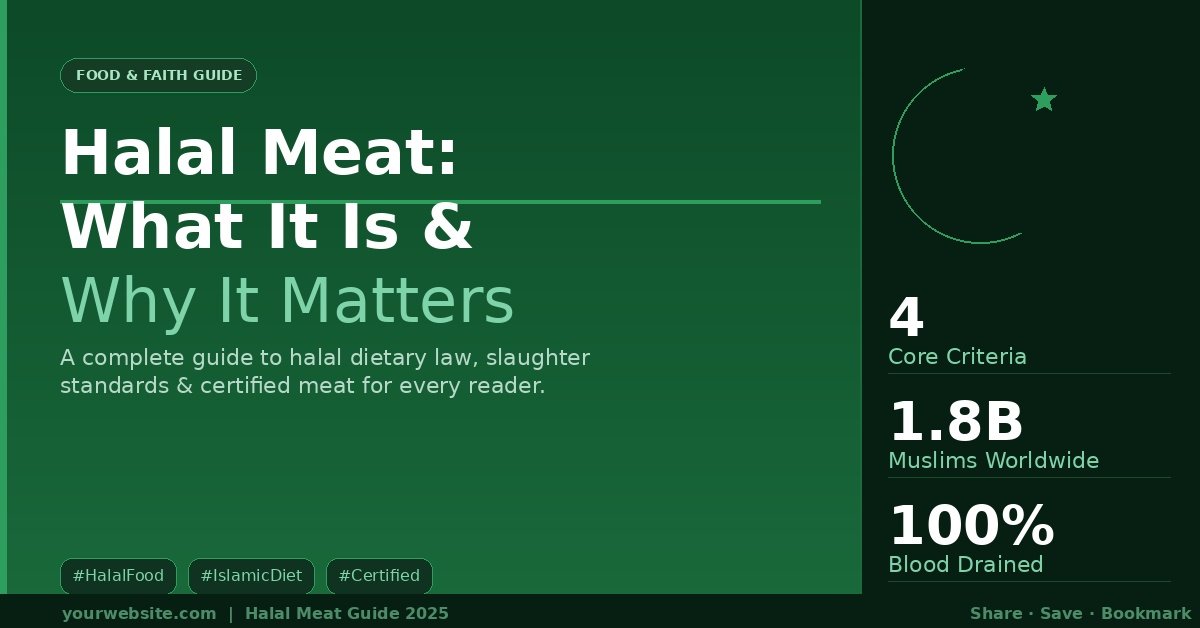
A clear, expert guide to understanding halal meat — from its religious foundations to what it means for your food choices today.
10 min readUpdated 2025Food & Nutrition
Whether you’re shopping for the first time, catering for Muslim friends, or simply curious — this guide explains exactly what halal meat is, how it’s prepared, what makes it different, and how to identify it with confidence.
In this article
- What does “halal” mean?
- The four criteria for halal meat
- How halal slaughter works
- Halal vs. conventional vs. kosher meat
- What meats are halal — and what are not?
- Reading halal labels and certifications
- Common questions answered
What Does “Halal” Actually Mean?
“Halal” is an Arabic word meaning “permissible” or “lawful.” In the context of food, halal meat refers to animal products prepared according to Islamic dietary law (Sharia). The opposite is “haram” — forbidden.
The concept of halal extends beyond meat to all aspects of life in Islam, but food — especially meat — is where it has the most practical and visible impact. For the world’s 1.8 billion Muslims, eating halal isn’t a lifestyle preference; it’s a religious obligation.
But halal meat is increasingly relevant beyond Muslim communities. Many non-Muslim consumers choose halal products for perceived quality, ethical slaughter standards, or simply because it’s what’s available in certain regions or restaurants.
The Four Core Criteria for Halal Meat
For meat to be considered halal, four key conditions must all be met — not just one or two.
1. Permissible animal
The animal must be a species that is lawful to eat under Islamic law — such as cattle, sheep, goat, chicken, or fish.
2. Blessing at slaughter
The name of Allah must be invoked (Bismillah) at the moment of slaughter. This is known as the Tasmiyah.
3. Blood fully drained
The blood must be completely drained from the animal. Blood is considered haram and must not remain in the meat.
4. Swift, humane cut
A sharp blade must sever the windpipe, oesophagus, and jugular veins in one swift motion, minimising suffering.
If any one of these conditions is not met, the meat is considered not halal — regardless of the animal species or how it was otherwise handled.
How Halal Slaughter Works
Understanding the slaughter process helps clarify what separates halal meat from conventionally produced meat. Here is a step-by-step overview:
- The animal must be alive and healthy — diseased or already-dead animals cannot be halal.
- The slaughterer must be a Muslim (or, according to many scholars, a Jewish or Christian person for beef and lamb, though this is debated).
- The name of Allah is spoken — “Bismillah, Allahu Akbar” — immediately before slaughter.
- A sharp knife severs the throat — cutting the carotid artery, jugular vein, windpipe, and oesophagus in one smooth motion.
- The animal is allowed to bleed out completely before any further processing.
- No other haram substances — alcohol, pork-derived products, or forbidden additives — are used in processing or marination.
What About Stunning?
This is where halal standards diverge. In many Western countries, animals are stunned before slaughter to render them unconscious. There is genuine scholarly debate about whether pre-slaughter stunning is permissible.
- Reversible stunning (such as low-voltage electric stunning) is accepted by many halal certifying bodies, provided the animal remains alive and is not killed by the stun itself.
- Captive bolt stunning (commonly used in beef processing) is rejected by stricter halal authorities because it often causes immediate brain death.
- Non-stunned slaughter is considered the purest form of halal by many scholars and is required by some certification bodies.
When buying halal meat, it’s worth checking the certifying body’s stance on stunning if this matters to you.
Halal vs. Conventional vs. Kosher Meat
How does halal meat compare to regular supermarket meat and to kosher meat, which follows Jewish dietary laws?
| Aspect | Halal | Conventional | Kosher |
|---|---|---|---|
| Religious blessing | Required (Tasmiyah) | None | Required (Shechita) |
| Blood drained | Yes | Not required | Yes (salted) |
| Slaughterer | Muslim (or Ahl al-Kitab) | Anyone | Trained Jewish shochet |
| Stunning allowed? | Debated / varies | Typically yes | Generally no |
| Pork forbidden? | Yes | No | Yes |
| Meat + dairy mixed | Allowed | Allowed | Forbidden |
Interestingly, many Muslims consider kosher meat an acceptable substitute in non-Muslim countries where halal is unavailable — though not all scholars agree on this.
What Meats Are Halal — and What Are Not?
Halal (Permissible) Meats
- Beef, veal, and buffalo
- Lamb, mutton, and goat
- Chicken, turkey, duck, and most poultry
- Camel
- Most fish and seafood (though some schools differ on shellfish)
- Venison and game animals (if slaughtered correctly)
Haram (Forbidden) Meats
- Pork and all pork derivatives — the most clearly forbidden animal in Islam
- Blood — including blood sausage and black pudding
- Carrion — animals that died naturally or before proper slaughter
- Predatory animals with fangs — lions, dogs, wolves
- Birds with talons — eagles, hawks, vultures
- Donkeys and mules
- Any halal animal not slaughtered correctly (e.g. without the blessing or not bled properly)
A Note on Alcohol in Cooking
Halal applies to more than just the slaughter. Meat marinated in alcohol, or cooked with wine-based sauces, becomes haram even if the base meat was halal. This is important in restaurant and food-service contexts.
Understanding Halal Labels and Certifications
Not all “halal” labels are equal. Genuine halal products carry certification from a recognised Islamic authority — not just a self-declaration by the manufacturer.
Here is what to look for when buying halal meat:
- Look for a certifying body’s logo — organisations like HMC (Halal Monitoring Committee), HFA (Halal Food Authority), ISWA, or regional bodies provide third-party oversight.
- Check the certification standard — some bodies are stricter than others, particularly regarding stunning.
- Verify country-specific bodies — in the UK, look for HMC or HFA; in the US, IFANCA or ISNA; in Australia, look for the Federation of Islamic Councils.
- Be cautious with self-certified labels — any business can print “halal” on a label without independent oversight. Look for a named certifier.
Common halal certifying bodies worldwide
HMC — UK HFA — UK IFANCA — USA ISNA — USA / Canada JAKIM — Malaysia MUIS — Singapore SANHA — South Africa ESMA — UAE FIANZ — New Zealand
Common Questions About Halal Meat
Is halal meat more expensive?
It can be, due to the certification process and the more labour-intensive slaughter method. However, in regions with large Muslim populations, prices are often competitive with conventional meat.
Does halal meat taste different?
Some people believe thorough blood draining gives halal meat a slightly cleaner taste and longer shelf life, though scientific evidence on flavour difference is limited. The diet and breed of the animal has far more influence on taste.
Is halal slaughter cruel?
This is a genuinely debated question. Proponents argue that a sharp, swift cut to the major neck vessels causes rapid unconsciousness due to blood pressure drop. Critics argue stunning is more humane. Veterinary opinion is divided, and welfare outcomes depend significantly on the skill of the slaughterman.
Can non-Muslims eat halal meat?
Absolutely. Halal certification relates to how the meat is prepared, not who can consume it. Many restaurants serve halal meat without advertising it, and many non-Muslim consumers eat halal regularly without issue.
Is all seafood halal?
Most fish is considered universally halal. Shellfish (shrimp, lobster, crab) is accepted by most Sunni scholars but rejected by some Shia scholars. It depends on the school of Islamic jurisprudence (madhab) being followed.
What is “halal-certified” cheese or gelatin?
This refers to non-meat products that contain animal derivatives — like rennet in cheese or gelatin from bones. For these to be halal, the source animal and slaughter method must comply with halal standards. Plant-based or microbial versions are generally considered halal without certification.
The Bottom Line
Halal meat is not simply a label — it is the outcome of a structured, faith-based process that governs which animals can be eaten, how they must be slaughtered, and how the meat is handled throughout the supply chain.
At its core, halal meat requires a permissible animal, an invocation of God’s name, swift and humane slaughter, and complete blood drainage. Any deviation from these requirements — regardless of how the meat is labelled — makes it non-halal.
For consumers, the most reliable way to ensure meat is genuinely halal is to look for third-party certification from a recognised Islamic authority, rather than relying on self-declared labels.
Whether you are Muslim and want to eat in accordance with your faith, or simply want to understand what’s on the label — the principles of halal meat are worth knowing
ALSO READ: What Is a Mocha? The Complete Guide to This Beloved Coffee Drink