
You’ve seen the problem. Thirty stickers. Six friends. How many stickers does each friend get?
Simple enough. But then the numbers get bigger, the phrasing shifts, and suddenly you’re staring at a sentence that seems to be asking three different things at once. What’s the total? What’s the group? What’s the unit?
This is the world of “how many units in one group” word problems — and it’s one of the most fundamental (and most misunderstood) problem types in elementary and middle school math.
The confusion almost always comes from the same place: students can compute the answer but don’t actually understand what the three numbers in the problem represent. Once you lock in that structural understanding, these problems become almost formulaic to solve.
This guide covers:
- What “units in one group” actually means mathematically
- The difference between the two types of division word problems (and why it matters)
- A repeatable 4-step strategy with worked examples
- Visual models (bar model, array, number line) that make the abstract concrete
- Common mistakes — and how to avoid them
- FAQ answers sized for “People Also Ask” boxes
Let’s get into it.
Part 1: What Does “Units in One Group” Actually Mean?
Before solving anything, you need to understand the three-part structure hiding inside every equal groups word problem.
Every problem of this type involves exactly three quantities:
| Term | What It Means | Example |
|---|---|---|
| Total | The overall amount (the whole) | 30 stickers |
| Number of groups | How many groups exist | 6 friends |
| Units per group | How many in each group | ? stickers per friend |
The question “how many units are in one group?” is asking you to find that third quantity — the per-group amount — when you already know the total and the number of groups.
The operation that finds it? Division.
Total ÷ Number of Groups = Units in One Group 30 ÷ 6 = 5 stickers per friend
That’s the core equation. Everything else in this guide is built on top of it.
Part 2: The Two Types of Division Word Problems
Here’s something most curricula don’t explain well enough: there are two fundamentally different types of division word problems, and they require different thinking — even though both use division to solve them.
Type 1: Partitive Division (How Many in Each Group?)
This is the “how many units in one group” type. You know the total and you know the number of groups. You’re splitting a total fairly across a known number of groups.
Example:
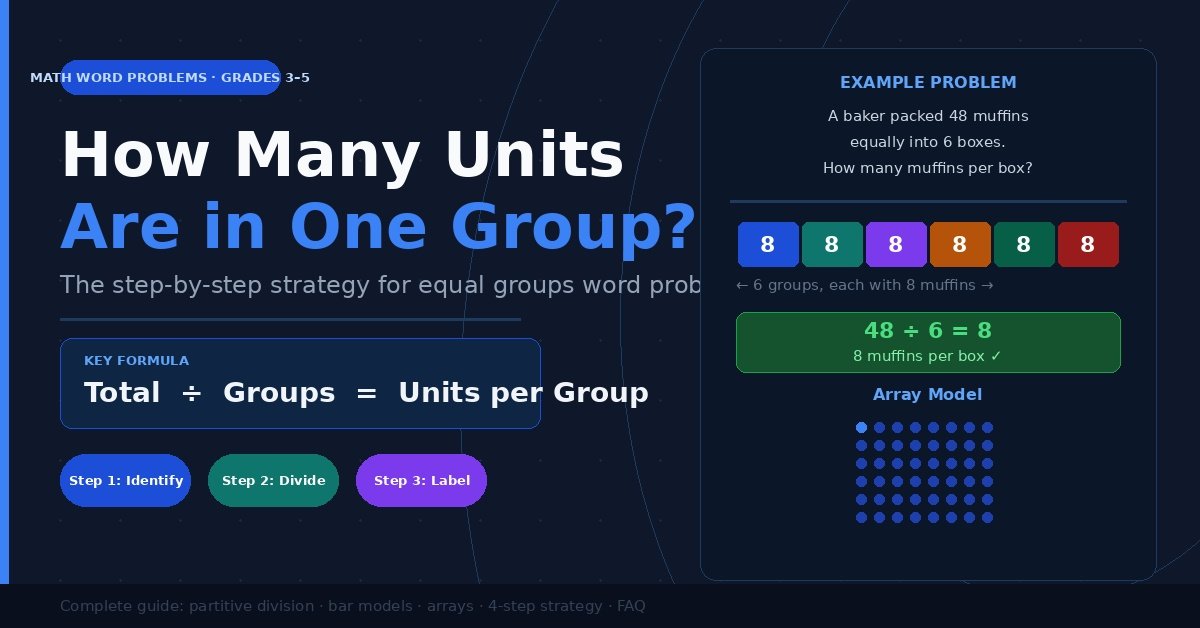
A baker made 48 muffins and packed them equally into 6 boxes. How many muffins are in each box?
- Total: 48
- Number of groups: 6 boxes
- Units per group: 48 ÷ 6 = 8 muffins per box
The mental model: Imagine dealing cards. You deal one card at a time to each person (each “group”) until you’re out. You’re partitioning the total.
Type 2: Measurement Division (How Many Groups?)
Here, you know the total and the size of each group. You’re figuring out how many groups fit.
Example:
A baker has 48 muffins. Each box holds 6 muffins. How many boxes does she need?
- Total: 48
- Units per group: 6 muffins per box
- Number of groups: 48 ÷ 6 = 8 boxes
Same numbers. Same answer. But a completely different question — and a different conceptual process.
Why does this distinction matter? Because students who mix these up often set up the wrong equation when the problem is more complex, or when they’re working backwards from an unknown.
Quick Test: Ask yourself — “Do I know how many groups there are, or do I know how many are in each group?” That one question tells you which type you’re dealing with.
Part 3: The 4-Step Strategy for Solving “Units in One Group” Problems
Use this framework every time:
Step 1: Identify the Three Quantities
Read the problem and label:
- Total = the whole amount
- Number of groups = how many groups are mentioned
- Units per group = what’s unknown (marked with “?”)
Step 2: Confirm You’re Solving for “Units Per Group”
Check: Does the question ask how many in each group / per person / for each ___? If yes, you’re doing partitive division.
Step 3: Write the Equation
Total ÷ Number of Groups = Units Per Group
Step 4: Solve and Label
Don’t just write the number. Write the unit (muffins, students, dollars, etc.). This habit prevents misreading the answer.
Worked Example 1 (Basic)
There are 35 apples divided equally into 7 baskets. How many apples are in each basket?
- Total: 35 apples
- Number of groups: 7 baskets
- Unknown: apples per basket
Equation: 35 ÷ 7 = 5 apples per basket
Worked Example 2 (Multi-Step)
A school bought 144 pencils. Each classroom gets an equal share. There are 12 classrooms. Each classroom then splits their pencils equally among 3 tables. How many pencils does each table get?
Step 1: Find pencils per classroom. 144 ÷ 12 = 12 pencils per classroom
Step 2: Find pencils per table. 12 ÷ 3 = 4 pencils per table
The structure doesn’t change — you just apply it twice.
Worked Example 3 (Finding the Unknown “Groups” When the Problem Is Reversed)
Some problems give you the units per group and ask for the total or the number of groups. Don’t panic — use the inverse relationship.
Each student needs 4 colored pencils. If the teacher has 60 pencils total, how many students can get a full set?
- Total: 60 pencils
- Units per group: 4 pencils per student
- Unknown: number of students (groups)
Equation: 60 ÷ 4 = 15 students
This is measurement division — but the same equation. The position of the unknown changes; the relationship doesn’t.
Part 4: Visual Models That Make This Click
Abstract numbers confuse students. These three visual tools make the concept concrete.
1. The Bar Model (Tape Diagram)
Draw one long bar representing the total. Divide it into equal sections — one for each group. Each section = one “unit per group.”
|---5---|---5---|---5---|---5---|---5---|---5---|
                      30 total
         ← 6 groups → each section = 5 units
2. The Array
Draw dots or squares arranged in rows and columns.
- Rows = number of groups
- Columns = units per group
- Total dots = total quantity
For 30 ÷ 6:
● ● ● ● ●   (Group 1)
● ● ● ● ●   (Group 2)
● ● ● ● ●   (Group 3)
● ● ● ● ●   (Group 4)
● ● ● ● ●   (Group 5)
● ● ● ● ●   (Group 6)
Count each row: 5. That’s your units per group.
3. The Number Line (Repeated Subtraction)
Start at 30. Jump back in groups of 5. Count how many jumps it takes to reach 0. Six jumps = 6 groups. Each jump = 5 units.
←5←  ←5←  ←5←  ←5←  ←5←  ←5←
0    5    10    15    20    25    30
Myth vs. Fact: Common Misconceptions About These Problems
| Myth | Fact |
|---|---|
| “Division always means the answer gets smaller.” | Not true when dividing by fractions or decimals. And context determines the meaning of the answer. |
| “You can only divide when one number goes evenly into another.” | Remainders are valid answers — they represent leftover units that don’t fill a full group. |
| “Multiplication and division are different operations.” | They’re inverse operations. If 6 × 5 = 30, then 30 ÷ 6 = 5 and 30 ÷ 5 = 6. Always. |
| “The bigger number always comes first in division.” | The total always goes first (as the dividend), regardless of size. |
| “Word problems need to be translated immediately into numbers.” | The best approach is to draw or label first, then write the equation. Rushing to numbers causes setup errors. |
What the Research Says About Teaching Word Problems
Students who are explicitly taught to identify the problem structure (rather than just key words like “divided by” or “each”) show measurably better transfer to novel problems. [Source: Fuchs et al., 2008, Journal of Educational Psychology]
A widely-cited error analysis found that over 60% of word problem mistakes at the elementary level are setup errors — students perform the correct calculation on the wrong quantities. [Source: NAEP Long-Term Trend Assessment, National Center for Education Statistics]
The Singapore Math bar model approach (partitive and quotative distinction explicitly taught) has been linked to significant gains in problem-solving flexibility in grades 3–5. [Source: Hoven & Garelick, 2007, Educational Leadership]
Teaching students to write unit labels with their answers (not just numerals) reduces context errors by helping students check whether the answer is conceptually sensible.
What Years of Teaching This Actually Shows
From working with thousands of students on math word problems across grade levels, one pattern shows up constantly: kids who struggle aren’t struggling with the arithmetic — they’re struggling with the representation. They don’t know what to draw.
The most effective intervention isn’t more practice problems. It’s spending 10 minutes at the start having students build the problem with physical objects — counters, blocks, drawings — before touching pencil to paper for calculation.
When a student physically distributes 24 counters into 4 groups and counts 6 in each group, they own that concept. The algorithm becomes a shortcut they chose — not a mystery procedure they memorized.
Teachers and tutors working with this problem type should:
- Require students to label what the unknown is before solving
- Ask “is your answer a number of groups or a number in each group?” after solving
- Use the check: answer × number of groups = total to verify
If the check fails, the setup was wrong — not the arithmetic.
FAQ Section (People Also Ask Optimization)
How do you find how many units are in one group?
Divide the total by the number of groups. The formula is: Total ÷ Number of Groups = Units per Group. For example, if 42 books are split equally into 7 boxes, divide 42 ÷ 7 = 6 books per box. Always label your answer with the correct unit.
What is the difference between “how many groups” and “how many in each group”?
These are the two types of division word problems. “How many in each group” (partitive division) means you know the number of groups and find the per-group amount. “How many groups” (measurement division) means you know the per-group amount and find the number of groups. Both use division, but they answer different questions.
How do you know what to divide in a word problem?
Identify the total (the whole amount), the number of groups, and the unknown. The total is always your dividend (what gets divided). If you’re solving for units per group, divide total ÷ number of groups. Use a bar model or array to visualize before setting up the equation.
Can multiplication help solve “units in one group” problems?
Yes. Division and multiplication are inverse operations. If you know the answer should satisfy: groups × units per group = total, you can use multiplication to check your division answer. Some students find it easier to think “what times the number of groups equals the total?” and use that as a missing factor approach.
What does “one group” mean in a math word problem?
“One group” refers to a single subset of the total when the total is divided equally. In the sentence “24 students are divided into 4 equal groups,” one group = 6 students. The word problem is asking you to find the size of that one representative group.
What if the division doesn’t come out evenly?
That gives you a remainder. The remainder represents units that are “left over” after forming complete groups. In real-world problems, you then decide what to do with the remainder — sometimes you round up (you need one more group), sometimes you drop it (only full groups count), depending on the context.
Conclusion
The “how many units in one group” word problem is really just one question asked in many disguises: if you split a total into equal groups, what’s in each one?
The key entities at the heart of every problem like this are the same three things — total, number of groups, and units per group — and the relationship between them is division. Once students lock in that three-part structure, identify which quantity is unknown, and choose a visual model to make it concrete, the arithmetic almost solves itself.
What’s changing in math education is the emphasis on conceptual reasoning over procedural speed. Problems that once showed up only in upper elementary now appear in standardized tests with added complexity — unknowns embedded in multi-step scenarios, fractions as divisors, real-world contexts that require interpretation before calculation. The structural thinking taught by equal groups problems is the foundation for all of it.
What to do next:
- Try the 4-step strategy on 3–5 problems from your current workbook or homework set
- Use the bar model for every new problem until the structure is automatic
- If you’re a teacher or parent: present a problem using physical objects first, then transition to drawing, then to the equation — that sequence builds lasting understanding
You Might Also Enjoy:
Caffeine Toxicity: Dosage Risks
Caffeine Intoxication: 5 Symptoms