You’ve seen the number scattered across the internet — “oolong tea has about 37mg of caffeine” — and it’s technically not wrong. It’s just dangerously incomplete.
That single number flattens a genuinely complex picture into something almost useless. A tightly rolled Taiwanese high-mountain oolong steeped for five minutes in near-boiling water can land close to 55mg per cup. That same tea, pulled at two minutes in water at 180°F, might give you half that. A heavily roasted Da Hong Pao prepared gongfu-style with short 30-second steeps? Probably even less per serving, spread across multiple infusions.
This guide is going to give you the real picture: the actual caffeine ranges for oolong, the six factors that move that number up or down, how oolong compares to every other major beverage, and — critically — why oolong’s caffeine feels different than coffee’s even when the milligrams are similar.
Whether you’re switching from coffee, managing a health condition, pregnant, or just curious, you’ll have a clear and actionable answer by the end.
So, Does Oolong Tea Have Caffeine?
Yes — definitively, unambiguously yes. Oolong tea is made from the Camellia sinensis plant, the same plant that produces green, white, black, and pu-erh tea. All Camellia sinensis teas contain caffeine naturally. There is no such thing as truly decaffeinated oolong in nature; any “decaf” version has been processed to remove most (but rarely all) of its caffeine.
The real question isn’t whether oolong has caffeine. It’s how much, and what you can do about it.
How Much Caffeine Is in Oolong Tea? The Real Numbers
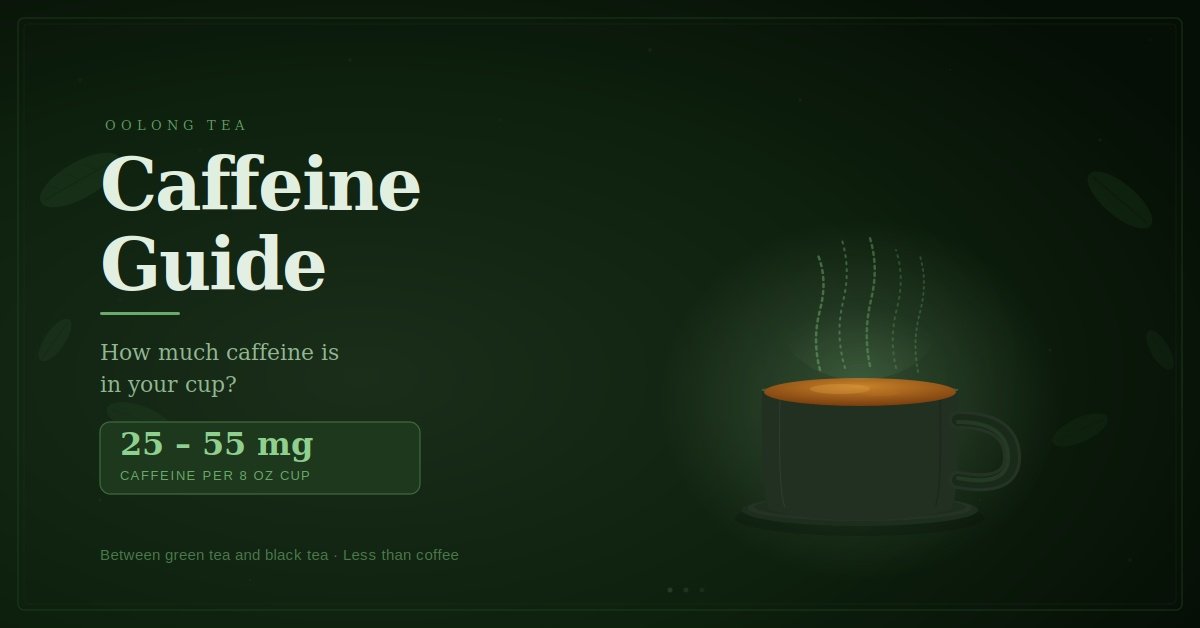
The most honest answer is a range: 25mg to 55mg of caffeine per 8oz (240ml) cup, with the sweet spot for a typical Western-style brew sitting around 30–45mg.
Here’s why that range exists, and why different sources give you wildly different figures:
A 2005 study published in the Journal of Food Science tested multiple oolong varieties and found caffeine ranging from as low as 16.6mg to as high as 55.4mg per cup depending on the specific variety and brewing conditions. Taiwan’s Tea Research and Extension Station (TRES) showed in separate testing that brewing temperature alone can double the caffeine extraction — water at 100°C (boiling) extracts roughly twice the caffeine as water at 80°C from the same leaves. A 2025 HPLC study published in PMC confirmed that longer brewing times significantly raise caffeine levels, while oolong’s L-theanine content remains relatively stable regardless of brewing temperature.
The averages you see cited across the web — 37mg, 50mg, 38mg — are each accurate to a specific brewing scenario. None of them is the number.
Caffeine Comparison Table: Oolong vs. Everything Else
| Beverage | Caffeine per 8oz / Standard Serving | Notes |
|---|---|---|
| Oolong tea | 25–55mg | Depends heavily on variety and brew method |
| Green tea | 15–35mg | Less oxidized, generally lower caffeine |
| White tea | 10–25mg | Young buds, lower caffeine per cup |
| Black tea | 40–70mg | Fully oxidized, highest among teas |
| Matcha | 60–80mg | Powdered; you consume the whole leaf |
| Coffee (drip) | 95–165mg | Significantly higher than any tea |
| Espresso (1 shot) | 60–75mg | Per 1oz shot; not 8oz |
| Pu-erh tea | 30–70mg | Fermented; caffeine varies by age and type |
Sources: Journal of Food Science (2005), Taiwan TRES data, FDA caffeine guidance, PMC 2025 HPLC study
The key takeaway: Oolong sits in a genuinely middle position. It has more caffeine than most green teas brewed similarly, less than most black teas, and dramatically less than coffee — typically about one-third to one-quarter of a standard cup of drip coffee.
The 6 Factors That Control How Much Caffeine Is in Your Cup
This is the section most articles skip, and it’s the most important part if you’re trying to manage your intake.
1. The Variety of Oolong
Oolong is not one tea — it’s a family of teas spanning a massive spectrum of oxidation (roughly 10% to 85%). The variety you choose is the biggest upstream variable.
| Oolong Variety | Oxidation Level | Approx. Caffeine per 8oz Cup |
|---|---|---|
| Baozhong (Pouchong) | ~10–15% | 20–30mg |
| High Mountain Oolong (Ali Shan, Li Shan) | ~20–30% | 30–45mg |
| Dong Ding | ~30–40% | 35–50mg |
| Tie Guan Yin (greener style) | ~20–30% | 25–40mg |
| Tie Guan Yin (roasted style) | ~40–60% | 25–40mg |
| Da Hong Pao | ~60–80% | 35–50mg |
| Eastern Beauty (Dong Fang Mei Ren) | ~60–85% | 35–55mg |
Note: These are approximate ranges from available research and industry data. Individual batches will vary.
Higher oxidation generally trends toward slightly higher caffeine — but roast level and brewing variables can override this entirely.
2. Roast Level
Heavily roasted oolongs (like a traditional charcoal-roasted Dong Ding or Wuyi rock oolong) often feel less stimulating, and there’s a real reason for that. Roasting slows caffeine extraction — the dense, charred exterior of the leaves releases caffeine more gradually during steeping. Roasted oolongs tend to deliver their caffeine over a longer window, which many people find smoother. If you want oolong with a gentler energy profile, roasted styles are worth exploring.
3. Water Temperature
This is the most powerful lever you have as a brewer. According to Taiwan’s TRES research, caffeine extraction nearly doubles between 80°C (176°F) and 100°C (212°F) brewing temperatures. Green-style oolongs are often recommended at 185–195°F anyway (to protect the delicate flavor), which conveniently also keeps caffeine extraction more moderate.
If you’re caffeine-sensitive: brew at 180–185°F. You’ll lose almost nothing in terms of flavor, and you’ll get meaningfully less caffeine.
4. Steeping Time
The relationship here is roughly linear in the short term. Research from the 2025 HPLC study confirmed that caffeine in tea infusions increases significantly with longer steep times. Brew for 2 minutes and you extract a fraction of what you’d get at 5 minutes. A well-established rule of thumb: 5 minutes of full-boil steeping extracts roughly 70% of the available caffeine from the leaf.
For a lighter cup: 2 minutes. For a fuller, more caffeinated cup: 4–5 minutes.
5. Leaf-to-Water Ratio
More leaves = more caffeine. This sounds obvious, but it’s easy to overlook when comparing “oolong caffeine” across different sources who are using different amounts of leaf. A generous gongfu ratio (5g per 120ml) extracts far more caffeine per volume than a light Western brew (2g per 240ml). Gongfu serving sizes are also much smaller per serving, which partially offsets this — but it depends on how many infusions you consume in one session.
6. Multiple Infusions (Re-steeping)
This is one of oolong’s most underappreciated features. The caffeine in the leaf is front-loaded: the first steep pulls out the largest share, and subsequent steeps deliver progressively less. Most oolong bags can be re-steeped 2–3 times; quality loose-leaf oolong steeped gongfu-style can go 6–8 rounds or more, with caffeine dropping with each infusion. If you’re watching your intake, drinking later steeps is a completely natural caffeine-reduction strategy with no additives or processing required.
Why Oolong Tea’s Caffeine Feels Different Than Coffee’s
Here’s something the numbers can’t fully capture: the subjective experience of oolong’s caffeine is genuinely different from coffee’s, and there’s a well-understood reason for it.
Oolong (like all Camellia sinensis teas) contains L-theanine, an amino acid that occurs almost exclusively in the tea plant. L-theanine crosses the blood-brain barrier and increases alpha brain wave activity — the brainwave state associated with relaxed, focused alertness. Numerous studies have confirmed this, including a 2008 paper in the Asia Pacific Journal of Clinical Nutrition. What this means in practical terms: L-theanine actively modulates the stimulant effect of caffeine, dampening the “fight or flight” activation that pure caffeine can trigger and replacing it with something closer to sustained, calm focus.
A 2014 review found that teas combining both caffeine and L-theanine increased alertness and attention within the first 1–2 hours of consumption with fewer of the anxious side effects associated with coffee. This synergy — sometimes called the “tea effect” — is why people who get anxious on coffee often tolerate oolong beautifully, even when the caffeine content is comparable.
The typical L-theanine-to-caffeine ratio in oolong provides what some researchers call an “alert calm” state — mentally engaged but not frantic. It’s functionally different from slamming caffeine alone.
Myth vs. Fact: Common Misconceptions About Oolong Tea and Caffeine
Myth: “More oxidized oolong = more caffeine, always.” Fact: Oxidation level has some influence, but brewing variables dominate. A light oolong brewed for 5 minutes in boiling water will often out-caffeinate a darker oolong brewed briefly at lower temperature.
Myth: “You can wash out all the caffeine by doing a short 30-second first steep and discarding it.” Fact: The “caffeine wash” method is popular but imprecise. A 30-second steep doesn’t remove a majority of the caffeine — it removes perhaps 20–30% of it. It will slightly reduce your caffeine intake per subsequent cup, but it won’t come close to making your tea “caffeine free.”
Myth: “Oolong has as much caffeine as coffee.” Fact: A typical cup of oolong contains roughly one-quarter to one-third the caffeine of a standard drip coffee. You’d need approximately two to three 8oz cups of oolong to match one cup of coffee at similar brewing strength.
Myth: “Decaf oolong is the same as herbal tea — no caffeine.” Fact: Even decaffeinated oolong retains trace amounts of caffeine (typically 2–5mg per cup). Herbal teas made from plants other than Camellia sinensis — chamomile, peppermint, rooibos — are naturally caffeine-free.
Myth: “Green oolong has less caffeine than dark/roasted oolong.” Fact: Roast level affects extraction rate and how the caffeine is experienced, not the total caffeine in the dry leaf. Roasted oolongs often feel milder because caffeine releases more slowly — not because there’s less of it.
Oolong Tea Caffeine: EEAT Perspective — What We’ve Seen in Practice
Working with specialty teas and helping people navigate the coffee-to-tea transition over years of practice, the mistake that comes up most often is this: people swap their morning coffee for oolong expecting to feel similar energy levels because they’ve read the caffeine is “roughly comparable” to some teas. Then they brew it like they brewed their coffee — too long, too hot, with too much leaf — and either get way more caffeine than expected, or they feel “nothing” because they went too light trying to be cautious.
The nuance that matters most in practice: oolong rewards deliberate brewing. It is not a “fill the infuser and walk away” tea. Two minutes vs. five minutes isn’t a small difference — it’s often the difference between a gentle morning lift and a full-on buzzed feeling. Anyone coming off coffee should start with a lighter brew ratio (around 2g per 8oz), water at 190°F, and a 2.5-minute steep. Adjust from there.
Additionally, from a population standpoint, people with anxiety disorders consistently report better tolerance of oolong than of equivalent caffeine doses from coffee or energy drinks — and the L-theanine research is compelling enough that this isn’t surprising. It’s not a substitute for medical advice, but it’s a pattern worth noting.
How Much Oolong Tea Is Safe to Drink Per Day?
The European Food Safety Authority (EFSA) and the FDA both recommend a daily caffeine limit of 400mg for healthy adults — the equivalent of roughly 8–15 cups of oolong depending on brew strength. In reality, 2–4 cups per day is where most regular oolong drinkers land, and that puts you well within safe limits at roughly 60–160mg of total caffeine.
Population-specific guidance:
- Pregnant or breastfeeding: Most clinical guidelines suggest capping caffeine at 200mg/day during pregnancy. At 30–45mg per cup, 3–4 light cups of oolong would approach that limit. Discuss with your healthcare provider.
- Caffeine-sensitive individuals: Start with a single light cup (2g leaf, 185°F, 2 minutes) and assess. Choose roasted or aged oolong styles, which many people find calmer.
- People with anxiety or heart conditions: The L-theanine in oolong genuinely mitigates some of caffeine’s edge, but it doesn’t eliminate it. If coffee triggers anxiety or palpitations, start with low-dose oolong and pay attention to your response.
- Before bed: Avoid oolong within 4–6 hours of bedtime if you’re caffeine-sensitive. Even 30–40mg of caffeine can interfere with sleep in susceptible individuals.
How to Brew Oolong Tea for More or Less Caffeine
You have real control here. Use these levers deliberately:
To maximize caffeine:
- Use more leaf (3g+ per 8oz)
- Use near-boiling water (200–205°F / 93–96°C)
- Steep for 4–5 minutes
- Use the first infusion only (highest caffeine concentration)
- Choose darker, less-roasted oolong varieties like Dong Fang Mei Ren or Da Hong Pao
To minimize caffeine:
- Use less leaf (1.5–2g per 8oz)
- Lower water temperature (175–185°F / 80–85°C)
- Steep for 2–2.5 minutes
- Drink later infusions rather than the first steep
- Choose heavily roasted or aged oolong styles
- Cold brewing (8–12 hours in cold water) extracts significantly less caffeine than hot brewing
FAQ: Oolong Tea Caffeine
Does oolong tea have caffeine?
Yes. Oolong tea is made from the Camellia sinensis plant and naturally contains caffeine. A standard 8oz cup brewed at typical Western settings contains approximately 25–55mg of caffeine, with 30–45mg being the most common range.
How does oolong tea caffeine compare to coffee?
A typical cup of oolong contains roughly one-quarter to one-third the caffeine of drip coffee. An 8oz coffee averages 95–165mg; oolong averages 30–45mg. You’d need two to three cups of oolong to match one cup of coffee.
Can I drink oolong tea before bed?
It depends on your caffeine sensitivity. If you’re caffeine-sensitive, avoid oolong within 4–6 hours of sleep. The moderate caffeine content is lower than coffee, but it can still delay sleep onset for sensitive individuals. The L-theanine has relaxing properties, but it doesn’t cancel out caffeine’s wakefulness effect.
Does brewing method affect oolong’s caffeine?
Significantly. Water temperature and steeping time are the two biggest variables. Brewing at 100°C (212°F) for 5 minutes extracts nearly twice the caffeine as brewing at 80°C (176°F) for 2 minutes from the same leaves. You have real, practical control over your caffeine dose.
Is oolong tea safe during pregnancy?
In moderation, yes. Most guidelines recommend limiting caffeine to 200mg per day during pregnancy. At 30–45mg per cup, 3–4 light cups would approach that limit. Always consult your healthcare provider for personalized guidance.
Why does oolong tea feel calmer than coffee at similar caffeine levels?
Oolong contains L-theanine, an amino acid that promotes alpha brain wave activity — a state of calm, focused alertness. Research confirms that the caffeine-plus-L-theanine combination produces sustained attention with fewer jitters than caffeine alone. This is why oolong’s 40mg can feel gentler than coffee’s 40mg.
Conclusion
Oolong tea has caffeine — that much is certain. What’s far less certain, and far more interesting, is how much you end up consuming, because that number is almost entirely in your hands.
The variety you choose, the temperature of your water, how long you steep, and whether you drink the first infusion or the fourth — these variables matter more than any single number you’ll find on a generic caffeine chart. The 37mg figure you’ll see most often is a middle estimate under one set of conditions. Your actual cup could be anywhere from 20mg to 55mg.
What makes oolong genuinely distinct isn’t just the caffeine math. It’s the L-theanine dynamic that shapes how that caffeine lands. For people who want the focus benefits of caffeine without the anxiety and crash that often follow — especially those stepping back from heavy coffee habits — oolong offers a physiologically different experience, not just a quantitatively smaller one.
As specialty tea culture continues to grow globally and more people look for nuanced alternatives to coffee, oolong’s place at the intersection of flavor complexity, manageable stimulation, and real health research is only getting stronger. In 2026, it’s less “alternative tea” and more “the smart choice for people who’ve thought about it.”
What to do next: If you’re ready to explore oolong beyond a generic tea bag, start with a high-mountain Taiwanese oolong brewed lightly at 190°F for 2.5 minutes — it’s the most accessible entry point into what this tea can actually do.