
In a world where customers have more choices than ever, the biggest competitive advantage isn’t your product — it’s your relationships. A client relationship partner is the professional bridge between your business and your clients’ long-term success.
Most businesses spend enormous energy acquiring new clients. But the real growth lever? Keeping and deepening the ones you already have. That’s exactly where a client relationship partner comes in.
This role has evolved significantly over the past decade. It’s no longer enough to have a dedicated account manager who checks in quarterly. Today’s clients expect a strategic partner — someone who understands their goals, anticipates their needs, and advocates for them internally.
Whether you’re a B2B firm, a professional services company, or a SaaS business, understanding what a client relationship partner does — and how to become one — can transform how your organization retains and grows revenue.
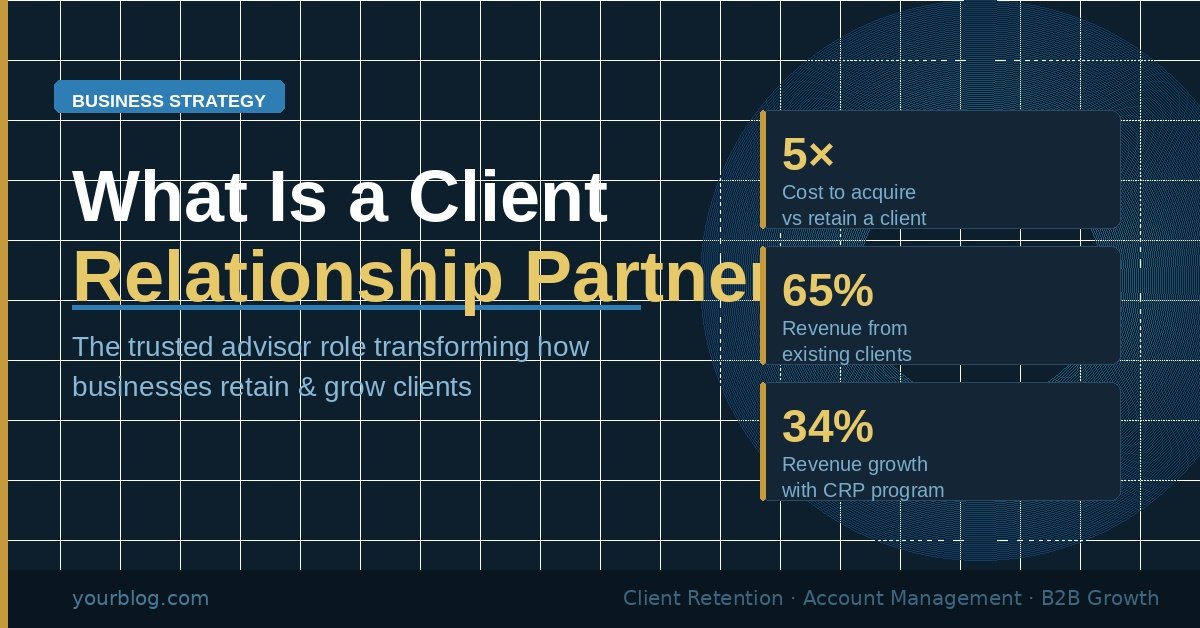
5×More expensive to acquire a new client than to retain one
65%Of a company’s business comes from existing clients
25%Revenue increase from just a 5% boost in client retention
What Is a Client Relationship Partner?
Direct answer: A client relationship partner is a senior professional responsible for building, maintaining, and strategically growing long-term relationships with key clients — acting as a trusted advisor rather than just a service provider.
Unlike a traditional account manager who focuses on transactions, a client relationship partner takes a consultative approach. They work to understand the client’s business deeply, align your company’s offerings with the client’s evolving needs, and ensure that the client feels genuinely supported — not just serviced.
This role exists across industries — from consulting and legal services to technology, finance, and marketing agencies — wherever long-term client retention is critical to business success.
Client Relationship Partner vs. Account Manager
These two roles are often confused. Here’s a clear breakdown:
| Dimension | Account Manager | Client Relationship Partner |
|---|---|---|
| Primary focus | Managing existing contracts and deliverables | Strategic growth and long-term trust |
| Engagement level | Reactive — responds to client needs | Proactive — anticipates and leads |
| Success metric | Contract renewals, satisfaction scores | Client lifetime value, net revenue retention |
| Relationship depth | Primary point of contact | Embedded strategic advisor |
| Conversation type | Operational and project-level | Business outcomes and future planning |
Core Responsibilities of a Client Relationship Partner
The day-to-day work of a client relationship partner spans relationship management, business development, and internal advocacy. Here are the core areas they own:
1. Building Trust at Every Level
Great client partners don’t just have one contact at a client company. They build relationships across multiple stakeholder levels — from day-to-day users of your service, to mid-level managers, to C-suite decision-makers.
This multi-threading approach ensures that the relationship survives personnel changes and deepens organizational commitment.
2. Understanding Client Goals — Not Just Their Requests
A client relationship partner invests time in understanding what success looks like for their client’s business. They ask questions that go beyond “what do you need this week?” and explore:
- What strategic objectives is the client working toward this year?
- What internal challenges are slowing them down?
- Where does your firm’s work connect to their most important priorities?
- What risks or market shifts should inform your approach together?
3. Growing the Account Strategically
Client relationship partners are not passive caretakers — they are active growth drivers. This means identifying opportunities to expand the relationship in ways that genuinely serve the client, whether through new services, expanded scope, or deeper integrations.
Expert Insight
The best client partners grow accounts by solving the client’s next problem before the client has fully articulated it. This kind of anticipatory value creation is what turns a vendor relationship into a true partnership.
4. Acting as an Internal Advocate
When a client has a problem, they need someone inside your organization fighting for their interests. Client relationship partners serve as the internal voice of the client — coordinating across departments, escalating issues, and ensuring the organization delivers on its promises.
5. Managing Risk and Client Health
A key part of the role is identifying early warning signs of dissatisfaction — declining engagement, missed feedback sessions, shifts in tone — and addressing them before they become churn risks.
Key Skills That Make a Great Client Relationship Partner
In short: The best client relationship partners combine emotional intelligence with business acumen — they’re as comfortable analyzing a client’s P&L as they are navigating a difficult conversation.
Here are the skills that separate good from exceptional in this role:
- Active listening — hearing what the client says and what they leave unsaid
- Strategic thinking — connecting your firm’s capabilities to the client’s long-term vision
- Commercial awareness — understanding revenue, profitability, and business drivers on both sides
- Influencing without authority — rallying internal teams around client needs without direct line management
- Executive communication — translating complex work into business language for senior stakeholders
- Resilience — handling friction, complaints, and difficult conversations without damaging the relationship
- Industry knowledge — being credible enough to advise, not just serve
How to Build a Client Relationship Partner Program
If your business is ready to invest in structured relationship management, here’s a practical roadmap for building or formalizing the function:
- Identify your top-tier accounts — Start by segmenting clients by revenue potential, strategic value, and growth opportunity. Your client relationship partners should focus on your most important relationships first.
- Define the role clearly — Create a role profile that distinguishes the client relationship partner from sales and account management. Set expectations around relationship depth, meeting cadence, and business reviews.
- Assign dedicated partners per account — Avoid splitting attention too thin. A strong client relationship partner can typically manage between five and fifteen strategic accounts, depending on complexity.
- Create a client engagement framework — Build a structured rhythm: quarterly business reviews, executive briefings, annual planning sessions, and regular informal check-ins.
- Measure relationship health, not just revenue — Track net promoter score, engagement frequency, stakeholder coverage, and expansion pipeline alongside financial metrics.
- Invest in continuous learning — Train your client partners in consultative selling, executive presence, industry trends, and change management.
What Clients Actually Want from a Relationship Partner
Understanding the client’s perspective is essential. When clients describe their ideal relationship partner, certain themes emerge consistently:
- Reliability — They follow through. Every time. Without being chased.
- Honest counsel — They tell clients what they need to hear, not just what they want to hear.
- Deep knowledge of the client’s business — They don’t need to be re-briefed at every meeting.
- Access and responsiveness — They’re reachable when it matters, and they respond quickly in a crisis.
- Proactive ideas — They bring insights, benchmarks, and suggestions unprompted.
- Coordination across your firm — They make working with your organization feel seamless, not fragmented.
Real-World Example
A mid-sized consulting firm assigned dedicated client relationship partners to their top 20 accounts. Within 18 months, average account revenue grew by 34%, and client churn dropped to under 4%. The key change wasn’t the quality of their work — it was the continuity and depth of the relationships they built.
Client Relationship Partners in the Age of AI and Automation
With AI now handling much of the transactional work of business — scheduling, reporting, status updates — the client relationship partner role has become more valuable, not less.
Automation removes the noise. It surfaces data faster, streamlines routine communications, and generates insights at scale. But it cannot replicate human judgment, empathy, or the ability to read a room.
The most effective client relationship partners today use AI as a productivity layer — using it to prepare for meetings, spot patterns in account health data, and draft communications — while spending their human energy on what machines cannot do: building genuine trust.
- AI tools for client intelligence — CRM insights, sentiment analysis, and usage data help partners stay ahead of client needs
- Automation for routine touchpoints — Frees up time for high-value, strategic conversations
- Human-led executive relationships — Still the irreplaceable core of the role
The Bottom Line
A client relationship partner is not a title — it’s a mindset. It’s the commitment to showing up as a true partner to your clients: curious about their business, proactive in your support, honest in your counsel, and relentless in your follow-through.
In markets where products and services are increasingly commoditized, the quality of your client relationships is one of the few genuinely defensible competitive advantages. Companies that invest in building this capability — structurally, not just aspirationally — consistently outperform those that don’t.
If your business relies on long-term client relationships, the question isn’t whether you need a client relationship partner program. The question is: how soon can you start building one?
CLICK HERE FOR MORE BLOG POSTS