
You had two beers at a wedding last Friday. Now, you’re facing a Phosphatidylethanol (PEth) test for a job, a court case, or a medical evaluation. The anxiety is real: Can a PEth test detect occasional drinking, or is it only designed to catch chronic alcoholics?
The short answer is yes, but the “why” and “how much” are where things get complicated. Unlike standard breathalyzers or urine tests that look for alcohol itself, the PEth test looks for a unique biomarker physically embedded in your red blood cells.
By 2026 standards, PEth is considered the “gold standard” for monitoring because it doesn’t lie—but it also doesn’t always distinguish between a celebratory toast and a weekend bender without the right context.
The Science: Why PEth is Different
PEth (Phosphatidylethanol) is a “direct” biomarker. It only forms in your body when ethanol reacts with your cell membranes. If you haven’t consumed alcohol, your PEth level should be effectively zero.
Because PEth lives inside the red blood cell, it stays there for the entire lifespan of that cell (up to 120 days), though its “measurable” concentration drops much faster.
Detection Windows at a Glance
| Drinking Pattern | Est. Detection Window | Likely PEth Range (ng/mL) |
| 1–2 Standard Drinks | 3–7 Days | < 20 ng/mL (Often “Negative”) |
| Occasional Binge (4+ drinks) | 10–14 Days | 20 – 100 ng/mL |
| Regular Social Drinking | 2–3 Weeks | 50 – 150 ng/mL |
| Chronic/Heavy Use | 4+ Weeks | > 200 ng/mL |
Can “One Night” Trigger a Positive?
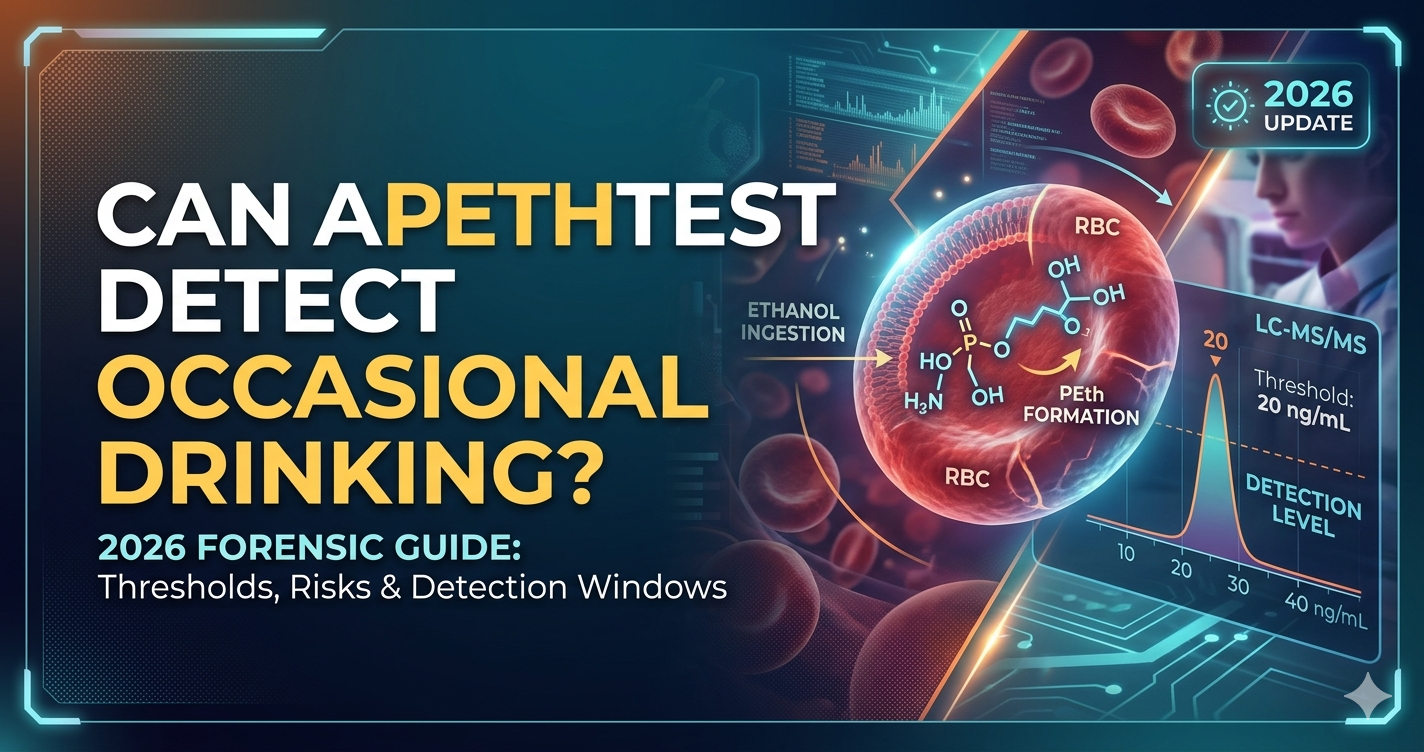
This is the most common question I see in forensic consulting. In 2026, most labs use a reporting threshold of 20 ng/mL.
- The “One-Drink” Scenario: A single standard drink is unlikely to push you over the 20 ng/mL threshold unless the test is taken within hours of consumption.
- The “Occasional” Scenario: If you drink 3–4 glasses of wine on a Saturday, your levels will likely spike above 20 ng/mL by Sunday. While those levels decay, they may remain “detectable” for 5 to 10 days.
Expert Insight: “We often see clients confused when they test positive after a week of abstinence. They forget that PEth doesn’t wash out with water or exercise; it has a half-life of roughly 4–7 days. If you start at 60 ng/mL, you’ll still be ‘positive’ (above 20 ng/mL) nearly a week later.”
Myth vs. Fact: Incidental Exposure
| Myth | Fact |
| Hand sanitizer can cause a positive. | Highly Unlikely. While 2026 research shows alcohol vapors can affect “wet” blood samples, modern Dried Blood Spot (DBS) collection methods and lab stabilizers have virtually eliminated this as a valid defense. |
| Kombucha will make me fail. | Rare. You would need to consume massive quantities of “hard” kombucha to reach the 20 ng/mL threshold. Standard non-alcoholic beverages (<0.5%) rarely trigger a positive. |
| PEth measures “drunk” behavior. | No. PEth measures ingestion volume over time. It cannot tell if you were intoxicated, only that ethanol was present in your system. |
Why Labs Are Moving Toward PEth
In the past, we relied on Liver Function Tests (LFTs) or CDT. The problem? Those can be “tricked” by health conditions or high-protein diets.
PEth is different because:
- Sensitivity: It catches “low-level” drinking that other blood tests miss.
- Stability: The sample doesn’t degrade as easily during shipping (if using DBS cards).
- Accuracy: In 2026, the use of LC-MS/MS (Liquid Chromatography-Mass Spectrometry) has made it nearly impossible to have a “false positive” from anything other than ethanol consumption.
High-Level Summary for 2026 Compliance
If you are an occasional drinker, a PEth test can detect your consumption, but the level reported is what matters.
- Results < 20 ng/mL: Generally interpreted as abstinence or very light, infrequent use.
- Results 20–200 ng/mL: Suggests moderate or recent significant drinking.
- Results > 200 ng/mL: Typically indicates chronic, heavy alcohol use (the “at-risk” zone for most legal and medical reviews).
FAQ: What You Need to Know Now
How can I lower my PEth levels quickly?
You can’t. Because PEth is bound to red blood cells, no amount of “detox” drinks, exercise, or hydration will speed up its removal. You must wait for the natural half-life decay.
Does age or gender affect PEth results?
Generally, no. Research in 2025 confirmed that while BMI can slightly influence the initial “spike” of PEth, the rate of decay is remarkably consistent across different demographics.
Will a single “slip-up” show on a child custody test?
If the “slip-up” was 3+ drinks and the test is within 7 days, it is highly likely to show up. However, the level will be significantly lower than that of a chronic drinker, which a forensic expert can interpret.
What about mouthwash or “hidden” alcohol?
Most forensic labs in 2026 distinguish between “incidental” exposure and “intentional” consumption. Levels from mouthwash usually fall below the 10-20 ng/mL cutoff used by major agencies like SAMHSA.
Next Steps: If you are concerned about an upcoming test, your best strategy is immediate abstinence. For those reviewing a positive result, consider requesting a “homologue breakdown” (16:0/18:1 vs 16:0/18:2) to provide a more detailed look at the drinking timeline.
ALSO READ: Do Quakers Drink Alcohol? The Surprising Truth About Modern Friends (Uniqueness)