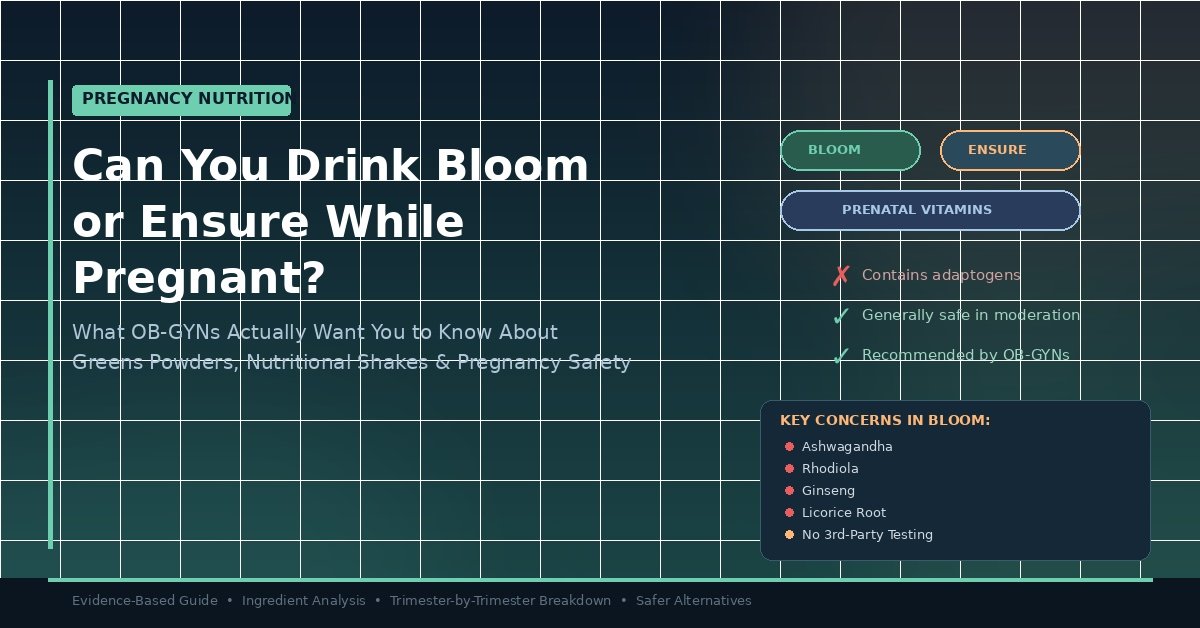
Can you drink Bloom while pregnant? What about Ensure — is it safe to sip on when morning sickness has you surviving on crackers? And the bigger question behind both: is Bloom Greens safe for pregnancy at all, or are you putting your baby at risk without realizing it?
You just found out you’re pregnant — or you’re deep into your first trimester, battling nausea, and staring at that tub of Bloom Greens on your counter wondering: is this still okay? Maybe you’ve been sipping Ensure to keep calories up on days when crackers are the only food that doesn’t make you gag. Or maybe TikTok just told you greens powders are the answer to every pregnancy nutrition concern, and you want the real story before you scoop.
Here’s the thing most wellness content won’t say plainly: not all supplements are created equal during pregnancy, and “natural” doesn’t mean “safe for your baby.” Bloom Greens and Ensure are two fundamentally different products with very different risk profiles for pregnant women. One contains adaptogens that most OB-GYNs would flag immediately. The other is generally considered safe — with a few caveats.
This guide breaks down exactly what’s in each product, which ingredients raise red flags during pregnancy, what the current medical guidance says, and what you should actually be reaching for when food alone isn’t cutting it. We’ll cover everything trimester by trimester, bust the myths floating around social media, and give you a framework for evaluating any supplement during pregnancy.
What’s Actually in Bloom Greens? An Ingredient-Level Look
Before you can decide whether Bloom is safe during pregnancy, you need to understand what you’re actually drinking. Bloom Greens & Superfoods is a powdered supplement containing over 30 ingredients, marketed primarily for gut health, bloating relief, and general wellness. It’s become enormously popular on TikTok, and the brand has leaned into that momentum with influencer partnerships — including some creators who’ve used it during pregnancy on camera.
Here’s where it gets complicated.
The ingredient profile includes:
- Organic greens blend: Wheatgrass, barley grass, spirulina, chlorella — generally considered safe in moderate amounts during pregnancy.
- Fruit and vegetable blend: Berry extracts, beet root, carrot — no major concerns here.
- Digestive enzyme blend: Amylase, cellulase, lipase, plus maltodextrin — enzymes are generally well-tolerated, though the maltodextrin addition raises questions about filler content.
- Probiotic blend: Lactobacillus acidophilus and other strains — probiotics are broadly considered safe and even beneficial during pregnancy, supporting gut health and immune function. However, the CFU count (colony-forming units) isn’t disclosed, so you don’t know the actual dose.
- Adaptogen blend (100 mg total): This is the problem area. The blend includes ashwagandha, rhodiola, American ginseng, eleuthero (Siberian ginseng), and licorice root. At 100 mg for the entire blend, the individual doses of each ingredient are small — but the concern isn’t just about dose. It’s about the category of ingredient itself.
Why Adaptogens Are a Red Flag During Pregnancy
Adaptogens are herbs that help the body modulate its stress response. In non-pregnant adults, they can be genuinely useful. During pregnancy, the picture changes dramatically.
Ashwagandha is the most-discussed concern. Modern safety references — including the Natural Medicines Comprehensive Database and multiple obstetric pharmacology resources — advise against ashwagandha use during pregnancy. The reasons include potential hormonal modulation, possible effects on uterine muscle activity, and historical reports suggesting abortifacient properties in traditional medicine contexts.
Rhodiola lacks sufficient pregnancy-specific safety data. Because it can influence the hypothalamic-pituitary-adrenal (HPA) axis — the system governing your body’s stress hormones — healthcare providers generally recommend avoiding it during pregnancy.
Ginseng (both American and Siberian/eleuthero) has estrogen-like effects that could theoretically interfere with the hormonal balance required for healthy pregnancy. Some animal studies have raised concerns, and the human safety data is simply not there.
Licorice root is one of the better-studied herbs in the context of pregnancy — and the data isn’t reassuring. High glycyrrhizin intake from licorice has been associated with higher cortisol exposure for the fetus and potential effects on cognitive development.
The bottom line: even though Bloom’s adaptogen blend is low-dose (100 mg split across five or more ingredients), the lack of pregnancy safety data for these herbs means most OB-GYNs and prenatal dietitians would tell you to avoid it.
The Third-Party Testing Gap
Another issue that rarely gets mentioned in casual product reviews: Bloom Greens does not carry third-party testing certifications like Informed Choice, NSF Certified for Sport, or USP Verified. This matters more during pregnancy than at any other time. Without third-party verification, you cannot independently confirm that the label matches the contents — including heavy metal levels, actual adaptogen doses, and the absence of contaminants. Prenatal dietitians consistently cite third-party testing as a non-negotiable for any supplement used during pregnancy.
Can You Drink Ensure While Pregnant? A Different Story
Ensure occupies a completely different category. Manufactured by Abbott Nutrition and on the market since 1973, Ensure is a nutritional shake designed to supplement caloric and micronutrient intake. It’s FDA-regulated as a medical food, which means it undergoes more rigorous manufacturing and labeling oversight than dietary supplements like greens powders.
The short answer: yes, Ensure is generally considered safe during pregnancy when used as a supplement — not a meal replacement.
Here’s what you’re getting in a standard 8-ounce serving of Ensure Original:
- Approximately 220 calories
- 9 grams of protein
- 27 vitamins and minerals, including vitamins A, C, D, E, K, B-complex, folate, calcium, and iron
- No adaptogens, no herbal extracts, no ingredients with unknown pregnancy safety profiles
When Ensure Makes Sense During Pregnancy
Ensure can be particularly helpful in specific situations:
Morning sickness and food aversions. When you can barely keep crackers down, a liquid nutritional supplement can help prevent an empty stomach — which often worsens nausea — while delivering calories and nutrients. The American College of Obstetricians and Gynecologists (ACOG) recommends avoiding an empty stomach as a strategy for managing morning sickness, and a shelf-stable shake fits that approach.
Difficulty gaining weight. Some women, particularly those carrying multiples or managing hyperemesis gravidarum, struggle to meet caloric needs. Ensure provides 220–350 calories per serving depending on the variety, with protein to support fetal growth.
Convenience during high-demand periods. Ready-to-drink options are shelf-stable and require zero preparation — a real advantage during exhausting first and third trimesters.
Ensure Varieties to Watch Out For
Not every Ensure product is interchangeable when you’re pregnant. Ensure Max Protein contains caffeine from coffee extract. While ACOG considers moderate caffeine intake (under 200 mg daily) acceptable during pregnancy, you should account for Ensure’s caffeine contribution alongside any coffee, tea, or chocolate you consume.
Some varieties also have higher sugar content, which is worth monitoring if you have gestational diabetes or are at elevated risk. Read labels carefully and discuss the specific Ensure product with your healthcare provider.
What Ensure Is Not
Ensure is not a prenatal vitamin. It does not contain pregnancy-specific doses of folic acid (you need 600 mcg daily), iron (27 mg daily is recommended during pregnancy), DHA omega-3s, or choline — all of which ACOG identifies as critical nutrients for fetal development. Think of Ensure as a caloric and nutritional bridge, not a replacement for your prenatal vitamin or a balanced diet.
Bloom vs. Ensure vs. Prenatal Vitamins: How They Compare
| Feature | Bloom Greens | Ensure Original | Prenatal Vitamin |
|---|---|---|---|
| Primary purpose | Gut health, general wellness | Caloric/nutritional supplementation | Targeted pregnancy nutrition |
| Contains adaptogens | Yes (ashwagandha, rhodiola, ginseng, licorice root) | No | No |
| Contains caffeine | Not listed, but check specific formulas | Some varieties (Max Protein) | No |
| Folic acid (600 mcg goal) | Not listed | Contains some folate, not pregnancy-targeted doses | Yes — typically 400–800 mcg |
| Iron (27 mg goal) | Listed but amount unclear | Contains some iron | Yes — typically 27 mg |
| DHA omega-3s | No | No | Some formulas include it |
| Third-party tested | No major certifications | FDA-regulated as medical food | Varies by brand |
| Protein per serving | Minimal | 9–30 g depending on variety | None |
| Calories per serving | ~30–50 | 220–350 | Negligible |
| Recommended during pregnancy | Not by most OB-GYNs | Generally yes, in moderation | Yes — standard of care |
The takeaway from this table should be clear: these three products serve different purposes, and only one of them — the prenatal vitamin — is specifically designed and recommended for pregnancy. Ensure supplements your diet; Bloom doesn’t have the safety profile to recommend during pregnancy.
Are Greens Powders Safe During Pregnancy? The Broader Picture
Bloom isn’t the only greens powder on the market, and this is a question many pregnant women ask about the entire category. The answer depends almost entirely on the specific product’s ingredients.
What makes a greens powder pregnancy-safe:
- Free of adaptogens (ashwagandha, rhodiola, maca, ginseng, holy basil, licorice root)
- Free of caffeine or caffeine-containing herbs (guarana, green tea extract, yerba mate)
- Third-party tested for heavy metals and contaminant purity
- Transparent labeling — no proprietary blends that hide individual ingredient amounts
- Free of excessive vitamin A in retinol form (beta-carotene is preferred during pregnancy, as excess retinol can be teratogenic)
What makes a greens powder risky during pregnancy:
- Proprietary blends that don’t disclose individual ingredient doses
- Adaptogenic herbs in any amount
- Hidden stimulants
- Lack of third-party testing — especially concerning because greens powders can accumulate heavy metals like lead, arsenic, and cadmium from the soil the ingredients are grown in
- High doses of individual vitamins that could exceed safe upper limits when combined with prenatal vitamins
Some products on the market are formulated specifically for pregnancy and breastfeeding, using only whole-food ingredients, transparent labels, and third-party testing. If you want the convenience of a greens powder during pregnancy, those specialized formulas are the right place to look.
Myths vs. Facts: Pregnancy Supplement Edition
Myth: “If it’s natural, it’s safe during pregnancy.” Fact: Many natural substances — including common herbs like ashwagandha and pennyroyal — have documented risks during pregnancy. “Natural” describes origin, not safety. Arsenic is natural. Poison ivy is natural. The relevant question is always whether a specific ingredient has been studied and shown to be safe during pregnancy.
Myth: “I drank Bloom before I knew I was pregnant, so I should be worried.” Fact: If you consumed Bloom in early pregnancy before a positive test, the adaptogen doses in the product are quite low (100 mg total for the entire blend). Mention it to your healthcare provider for personalized reassurance, but this is generally not a cause for alarm. The concern is more about continued daily use throughout pregnancy.
Myth: “Ensure can replace my prenatal vitamin.” Fact: Ensure and prenatal vitamins serve completely different functions. Ensure provides calories, protein, and a broad vitamin/mineral profile. Prenatal vitamins deliver pregnancy-specific doses of folic acid, iron, DHA, and other nutrients critical for fetal development. You need both a prenatal vitamin and a balanced diet. Ensure can supplement that foundation — never replace it.
Myth: “Greens powders give you the same nutrients as eating vegetables.” Fact: Greens powders can contribute some micronutrients, but they don’t replicate the fiber, water content, or full phytonutrient diversity of actual vegetables. They also can’t replace the folate, iron, and DHA your baby needs. At best, they’re a complement to real food — never a substitute.
Myth: “My friend drank Bloom throughout her pregnancy and her baby is fine, so it must be safe.” Fact: Individual anecdotes don’t establish safety. Many exposures during pregnancy may not cause obvious harm in a single case but could carry population-level risks or subtle developmental effects that aren’t immediately visible. Medical recommendations are based on systematic evidence, not individual stories.
What Your OB-GYN Actually Wants You to Prioritize
Rather than trying to optimize your supplement stack, the most evidence-backed approach to pregnancy nutrition is straightforward. ACOG and the Dietary Guidelines for Americans (2020–2025) agree on several key priorities:
A daily prenatal vitamin containing at least 400 mcg folic acid, 27 mg iron, calcium, vitamin D, and ideally DHA and choline. Notably, research has found that no commercially available over-the-counter prenatal vitamin contains adequate amounts of all ACOG-recommended nutrients — which is why dietary intake still matters enormously.
A varied diet rich in fruits, vegetables, whole grains, lean protein, and healthy fats. The additional caloric needs of pregnancy are modest — roughly 340 extra calories per day in the second trimester and 450 in the third.
Key nutrients to track: Folic acid (600 mcg/day), iron (27 mg/day), calcium (1,000 mg/day for women 19–50), vitamin D (600 IU/day minimum), choline (450 mg/day), DHA omega-3s (200 mg/day minimum, with emerging guidelines suggesting up to 1,000 mg for preterm birth risk reduction).
Caffeine moderation. ACOG’s guidance suggests keeping caffeine under 200 mg per day, though some newer research raises questions about whether any amount is completely without risk. Be aware of hidden caffeine sources — including some Ensure varieties and greens powders containing green tea extract.
An Expert Perspective on Pregnancy Supplement Safety
Having reviewed the ingredient panels of dozens of greens powders and nutritional supplements alongside the current obstetric and nutritional literature, the pattern is clear: the wellness supplement industry moves faster than the safety research — especially for pregnancy. Products like Bloom Greens are formulated for the general wellness market and aren’t designed with the unique vulnerabilities of pregnancy in mind.
The most common mistake expecting mothers make isn’t choosing the “wrong” supplement. It’s assuming that supplements marketed as healthy are automatically pregnancy-safe. The FDA does not require supplement manufacturers to prove safety before a product hits shelves — that burden falls on the consumer and their healthcare provider.
If you’re evaluating any supplement during pregnancy, three questions cut through the noise:
- Does this product contain adaptogens, stimulants, or herbs without established pregnancy safety data? If yes, skip it.
- Is it third-party tested for contaminant purity? If not, the risk/reward calculation doesn’t favor it during pregnancy.
- Does it replace or complement my prenatal vitamin and diet? Supplements should fill gaps in a solid foundation — not become the foundation itself.
Frequently Asked Questions
Can you drink Bloom Greens while pregnant?
Most OB-GYNs and prenatal dietitians advise against it. Bloom Greens contains adaptogens including ashwagandha, rhodiola, ginseng, and licorice root — herbs that lack pregnancy safety data and may affect hormones or uterine activity. The product also does not carry third-party testing certifications. If you want a greens powder during pregnancy, look for one specifically formulated for pregnant women, free of adaptogens and caffeine.
Is Ensure safe to drink during pregnancy?
Yes, Ensure is generally considered safe during pregnancy when used in moderation as a nutritional supplement. It can be particularly helpful during episodes of morning sickness or when appetite is low. However, it should not replace prenatal vitamins or a balanced diet. Be cautious with varieties like Ensure Max Protein that contain caffeine, and monitor sugar intake if gestational diabetes is a concern.
What if I drank Bloom before I knew I was pregnant?
This is usually not cause for significant concern. The adaptogen blend in Bloom is low-dose (100 mg total for the entire blend), and brief exposure in very early pregnancy is unlikely to cause harm. Still, mention it to your healthcare provider at your next appointment for personalized guidance, and stop using the product once you know you’re pregnant.
Are there pregnancy-safe greens powders?
Yes. Look for greens powders that are specifically marketed for pregnancy, free of adaptogens and caffeine, carry third-party testing certifications (such as Informed Choice or NSF), and use transparent ingredient labeling rather than proprietary blends. Some brands have been formulated by prenatal dietitians and tested for heavy metal purity.
Can Ensure help with morning sickness?
Ensure can help manage morning sickness indirectly by preventing an empty stomach, which often makes nausea worse. Its liquid form may also be easier to tolerate than solid foods on difficult days. That said, the taste doesn’t agree with everyone — if it triggers your gag reflex, it won’t be helpful. Some women find it more palatable when served cold or blended with ice.
How many Ensure shakes can I have per day while pregnant?
One serving per day is the general guideline most healthcare providers suggest. Drinking more could contribute excess calories and sugar, especially from flavored varieties. Always discuss your specific caloric and nutritional needs with your OB-GYN or a registered dietitian, as individual requirements vary significantly based on your pre-pregnancy weight, activity level, and pregnancy complications.
The Bottom Line
Bloom Greens and Ensure answer very different questions for pregnant women — and they deserve very different answers. Bloom’s adaptogen content puts it in the “avoid during pregnancy” category for most healthcare providers, regardless of the low doses involved. The lack of third-party testing adds another layer of uncertainty that simply isn’t worth the risk when you’re growing a human.
Ensure, on the other hand, sits comfortably in the “generally safe, use as a supplement” category. It’s been on the market for over 50 years, it’s FDA-regulated, and it can serve a genuine purpose when morning sickness, low appetite, or caloric needs make solid food impractical.
But neither product replaces the cornerstone of prenatal nutrition: a quality prenatal vitamin and a balanced diet rich in whole foods. As research evolves — particularly around nutrients like choline, DHA, and the growing understanding of the maternal microbiome — the advice may get more nuanced. For now, the approach that virtually every major medical organization endorses is simple: whole foods first, prenatal vitamins daily, and caution with anything that hasn’t been specifically studied for pregnancy safety.
Your next step: Bring your current supplement list — including any greens powders, protein shakes, or nutritional drinks — to your next prenatal appointment. Your OB-GYN or midwife can evaluate each one against your individual health profile. If you’re looking for personalized nutrition guidance, consider working with a registered dietitian who specializes in prenatal care.
ALSO READ
MOXē US Foods: The Complete Guide to the Foodservice App That’s Changing How Operators Order
Pumpkin Painting Ideas:30+ Creative Designs for Every Skill Level